



Agencies hide behind complex jargon, make impossible guarantees, spike communication around invoices, deflect blame when results fail, and keep you in the dark about what’s working. Learn the warning signs before you burn through $50k+ with an agency running templates instead of solving your growth problem.
Watch for these red flags:
-
Language fortresses where simple tactics get wrapped in proprietary framework talk
-
Guaranteed results promises (either incompetence or dishonesty)
-
Communication patterns tied to billing cycles instead of partnership
-
Blame deflection when campaigns don’t work
-
Black box reporting with metrics disconnected from revenue
I’ve watched founders burn $50k, $100k, sometimes more with agencies that sounded perfect in the sales call but delivered nothing except excuses and vague updates.
The pattern repeats. Big promises. Fancy frameworks. Proprietary systems. Then silence. Then scrambling when the invoice hits. Then more silence.
Here’s what I’ve seen in working with dozens of founders: agencies are way more confident about their work than clients are satisfied with the results. There’s a fundamental disconnect in how agencies see their value versus what clients experience.
Trust between agencies and clients dropped 11% between 2016 and 2018. It’s gotten worse since then.
I’ll walk you through the red flags I’ve seen destroy founder-agency relationships. These aren’t subtle. Once you know what to look for, they’re obvious.
What Is the Language Fortress Red Flag?
You’re in a sales call. The agency rep starts talking about their “proprietary multi-touchpoint attribution modeling framework with AI-enhanced conversion pathway optimization.”
Sounds impressive.
It’s Google Analytics with a custom dashboard. That’s it.
I’ve seen this play out dozens of times. Agencies take something straightforward like A/B testing or audience segmentation and wrap it in language that sounds like you need a PhD to understand it.
The goal is simple: make you think you can’t possibly do marketing without hiring experts who speak this secret language.
When you strip away the jargon, the stuff agencies do isn’t complicated. The value comes from knowing which simple things to do and when, not from making simple things sound impossible.
The test: Ask them to explain their process like you’re explaining it to your team. If they won’t simplify it, they’re either hiding something or don’t understand what they’re doing.
Bottom line: Complex jargon masks simple tactics. The value comes from knowing which simple things to do and when, not from making basic marketing sound impossible.
Why Are Guaranteed Results a Red Flag?
“We guarantee 10 qualified leads per month.”
“We guarantee first-page Google rankings in 90 days.”
“We guarantee 3X ROAS or your money back.”
Run.
When an agency guarantees specific results, one of two things is happening. Either they don’t understand how marketing actually works, or they’re lying to close the deal.
Marketing has too many variables outside anyone’s control. You can’t guarantee results because you don’t control the market, the competition, how people respond to messaging, or a dozen other factors that influence outcomes.
Digital marketing success depends on your website conversion effectiveness, competitive landscape shifts, and search patterns. No agency controls those variables.
The really sketchy ones build in escape hatches. They’ll guarantee results but bury conditions in the contract like “as long as you implement our recommendations” or “provided your product meets our quality standards.”
So when they don’t deliver, they point to that one time you took three days instead of two to approve something. Suddenly it’s your fault the guarantee didn’t pan out.
What a real partner says: “Here’s what we think will work based on what we’ve seen, but we need to test and adapt because your situation is unique.”
They’re honest about uncertainty instead of fabricating certainty to make the sale feel safer.
Bottom line: Guarantees signal either incompetence or dishonesty because marketing has too many uncontrollable variables. Real partners acknowledge uncertainty and commit to testing.
What Is the Invoice-Cycle Communication Pattern?
This one is subtle.
You sign with an agency. First month, they’re responsive. Lots of communication. Updates flowing. Then… silence.
You send a message asking for an update. No response for three days.
You schedule a call to get basic information about what’s happening with your own marketing. They show up unprepared or give vague answers like “we’re working on it” or “it’s in progress.”
Then, like clockwork, when the next invoice is about to hit, they ramp up communication. Tasks get closed. Reports get sent. Suddenly they’re available.
I’ve had founders tell me they felt like they were managing their agency instead of the agency managing their marketing. They’re chasing down deliverables, asking for reports that should be automatic, reminding the agency about things that were supposed to happen.
Backwards.
A real partner anticipates what needs to happen next and comes to you with “here’s what we’re doing this week and why” before you even have to ask.
The pattern to watch: Track when you hear from your agency. If communication spikes around billing cycles and goes quiet the rest of the month, you’re just another account on their list.
Bottom line: Communication spikes around billing cycles and silence the rest of the month means you’re an account number, not a partner. Real partners stay proactive without prompting.
How Do Agencies Deflect Blame for Poor Results?
Results aren’t coming in. You push for real answers.
Here’s what bad agencies say:
“Your industry is just really competitive right now.”
“We need more budget to see real results.”
“Your offer isn’t quite dialed in yet.”
“Facebook’s algorithm changed.”
It’s always some version of “it’s not us, it’s you.”
Platforms change all the time. Markets shift. Competition exists. A good agency adapts to those changes instead of using them as excuses.
What they’re really doing is deflecting. Because if they admit the strategy isn’t working, they have to do the hard work of diagnosing why and trying something different. That takes time and effort they don’t want to invest when they’re managing 30 other accounts.
Here’s the data: poor communication and inability to demonstrate value rank as the top reasons clients leave agencies. Notice what’s not the top reason? Pricing ranks only 6th.
Founders don’t leave because of cost. They leave because agencies won’t take responsibility for results.
What changes with a real partner: They come to you before you come to them. “Hey, we ran this for two weeks and the numbers aren’t where we want them… here’s what we’re seeing and what we’re testing next.”
They treat failure as data, not as someone’s fault.
Bottom line: Bad agencies blame your budget, market, or product when results fail. Real partners diagnose the problem, share what they learned, and adjust strategy.
What Is the Black Box Reporting Problem?
You’re paying $5K, $10K, maybe $15K a month.
You ask what’s actually being done with your money.
You get a report full of metrics that don’t connect to revenue. Impressions. Reach. Engagement rate. Click-through rate.
But you can’t see the path from those numbers to actual customers or cash collected.
This is the Black Box approach. Agencies keep you in the dark about what’s actually happening because if you understood it, you’d realize you’re not getting what you’re paying for.
I track data from attention all the way down to cash collected. This way we know what needs to improve and where the problem actually is.
Are people seeing the ads but not clicking? That’s a messaging problem.
Are they clicking but not converting to leads? Something’s wrong with the landing page or the ask is too big.
Are they becoming leads but not taking the next step? Either the follow-up isn’t working or we’re attracting the wrong people.
Tracking the full chain shows you what actually needs attention. Without that visibility, you’re just hoping the agency knows what they’re doing.
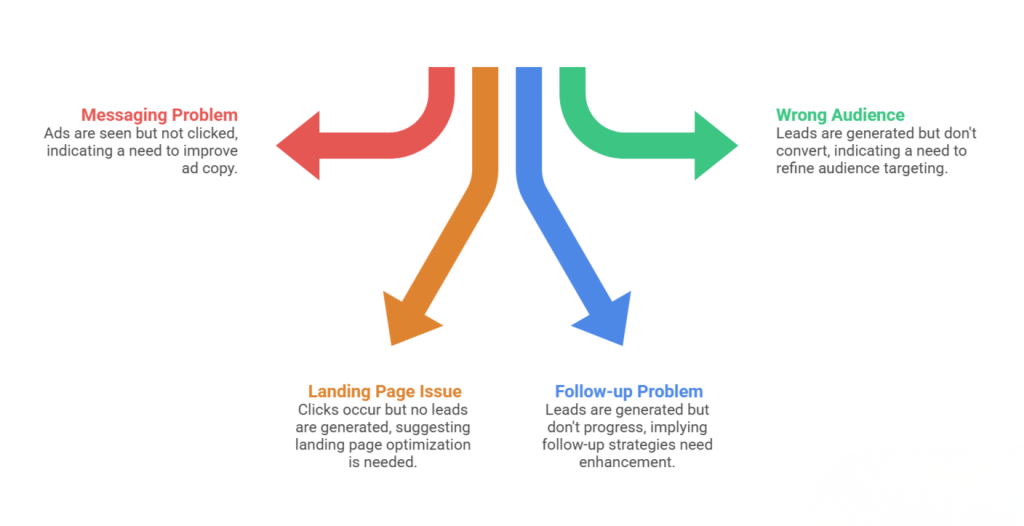
The question to ask: “Can you show me the full path from ad spend to revenue, and where the drop-offs are happening?”
If they can’t or won’t, they’re keeping you in the dark on purpose.
Bottom line: Metrics disconnected from revenue keep you in the dark. Demand full-funnel visibility from attention to cash collected so you know where problems actually live.
Why Is Specialist Fragmentation a Problem?
You hire an agency to run ads.
Ads are running but leads aren’t converting.
The agency says “that’s not our department, you need to hire someone for email nurturing.”
So you hire an email specialist.
Emails are going out but people aren’t booking calls.
“That’s a sales problem, not a marketing problem.”
Now you’re managing three different vendors who don’t talk to each other, and nobody takes responsibility for the actual outcome you care about: revenue.
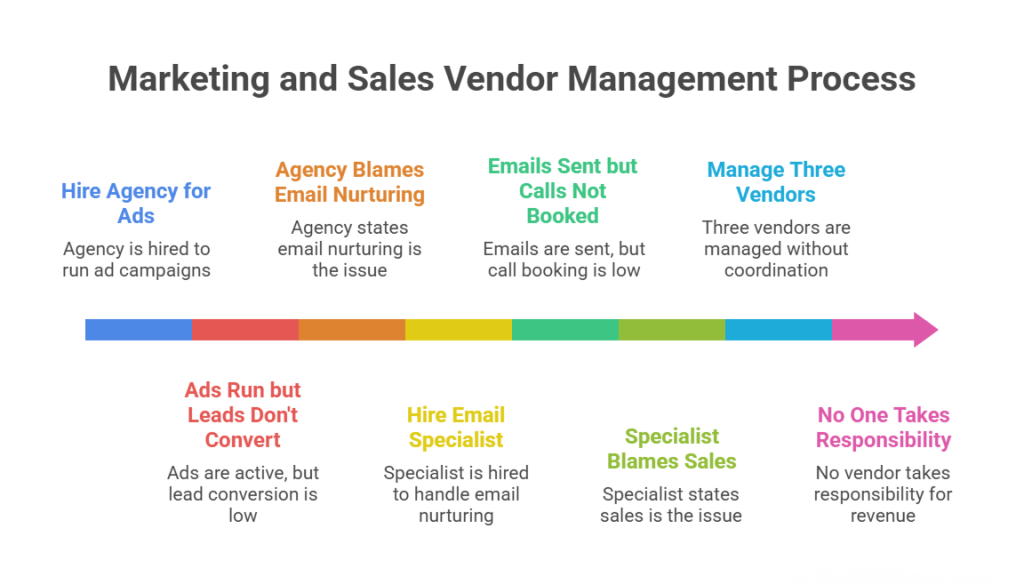
This is what happens when you work with separate specialists instead of integrated partners. Each one optimizes their little piece without caring about the whole system.
The ad agency gets paid whether leads convert or not. The email person gets paid whether calls get booked or not. Nobody’s incentive is aligned with your actual goal.
What integration looks like: One partner who tracks from attention to cash collected and can fix problems anywhere in that chain. If ads are working but nurturing isn’t, they fix the nurturing. If leads are good but sales isn’t closing, they help diagnose that too.
Hiring an agency for every funnel touchpoint creates disconnects. You need someone who owns the whole system.
Bottom line: Hiring separate specialists for each funnel stage creates disconnects and misaligned incentives. You need one partner who owns the whole system and fixes problems anywhere in the chain.
What One Question Reveals If an Agency Is a Real Partner?
You’re sitting in a sales call with an agency right now.
Here’s the one question that immediately tells you whether this agency is a partner or just another account on a list:
“What happens when something we try doesn’t work?”
Listen to how they answer.
If they get defensive, start talking about how rarely that happens, or immediately pivot to their track record… that’s a red flag. They’re more worried about protecting their reputation than solving your problem.
A real partner will say something like “we figure out what it’s telling us and adjust.” They’ll talk about their process for diagnosing why something failed and what they test next.
They won’t act like failure is this rare exception. They’ll treat it like a normal part of finding what works.
Because here’s the truth: SEO traction takes about 3-6 months because campaign performance stabilizes only after you’ve collected enough data. Any agency promising faster results is either lying or using shortcuts that will damage long-term performance.
Growth is something built and sustained through research, strategy, testing, optimization, and iteration. Not magic. Not guarantees. Not proprietary frameworks.
Just honest work and honest communication about what’s working and what isn’t.
Bottom line: Ask “What happens when something we try doesn’t work?” and listen for diagnosis language versus defensive language. Real partners treat failure as normal data collection.
What Does a Real Marketing Partner Look Like?
I’ve spent this whole article telling you what to avoid.
Let me tell you what to look for instead.
A real partner asks about your business before they talk about tactics. They want to understand what’s actually broken, not just deploy their standard playbook.
They’re proactive. You don’t have to chase them for updates. They come to you with “here’s what we’re seeing, here’s what we’re learning, here’s what we’re changing.”
They track the full funnel. Not just ad metrics. Not just lead volume. They show you where people are dropping off and what they’re doing to fix it.
They’re honest when things don’t work. No excuses. No blame. Just “this didn’t work, here’s what we learned, here’s what we’re testing next.”
They build systems you own. Not rented results that disappear when you stop paying them. Actual assets that compound over time.
And here’s the big one: they make you feel seen. You’re not just another account. You’re a business they’re genuinely invested in growing.
That’s the difference between an agency running a playbook and a partner solving your actual problem.
Most founders just want to know what’s being done, what’s being learned, and what’s being changed to improve results. Growth isn’t magic. It takes time, testing, and adaptation.
Find a partner who gets that, and you’ll save yourself a lot of money and frustration.
FAQ: Common Questions About Agency Red Flags
How long should I wait before deciding an agency isn’t working?
Look for proactive communication and diagnostic thinking in the first 30 days. If you’re chasing updates or hearing vague progress reports by week three, the pattern won’t change. Real results take 3-6 months, but real partnership shows up immediately.
What if my agency blames my product or budget when results don’t come?
Blame deflection means they’re protecting their reputation instead of diagnosing your problem. A real partner says “here’s what the data shows us” and adjusts strategy. They treat failure as information, not as someone’s fault.
Should I trust agencies that offer guarantees if they have good reviews?
No. Guarantees signal either incompetence (they don’t understand variables they can’t control) or dishonesty (they’re closing deals with promises they know they can’t keep). Good reviews don’t change the math on uncontrollable variables.
How do I know if I’m getting real reporting or Black Box metrics?
Ask “Can you show me the full path from ad spend to revenue and where drop-offs happen?” If they show impressions and clicks without connecting them to actual customers and cash collected, you’re getting vanity metrics.
What’s wrong with hiring specialist agencies for different parts of my funnel?
Each specialist optimizes their piece without accountability for the whole system. The ad agency gets paid whether leads convert. The email person gets paid whether calls book. Nobody’s incentive aligns with your goal: revenue.
Is it normal for agencies to go quiet between monthly reports?
No. That’s the invoice-cycle communication spike. Real partners stay embedded in your reality and communicate based on what’s happening, not when bills are due. Track when you hear from them. If communication spikes around billing and disappears otherwise, you’re just an account number.
How much should I expect to invest before seeing results from an agency?
Campaign performance stabilizes after 3-6 months of data collection. Anyone promising faster results is either lying or using shortcuts that damage long-term performance. Budget depends on your market, but transparency about what’s being learned should happen immediately.
What does “proprietary system” or “proprietary framework” usually mean?
It’s standard tactics wrapped in complex language to create artificial differentiation. When you ask them to explain it simply, they either can’t (they don’t understand their own process) or won’t (they’re hiding how basic it is).
Key Takeaways
-
Complex jargon and proprietary frameworks usually hide simple tactics. The value should come from knowing what to do and when, not from making basics sound impossible.
-
Guaranteed results signal incompetence or dishonesty. Marketing has too many uncontrollable variables. Real partners acknowledge uncertainty and commit to testing.
-
Communication patterns reveal partnership quality. If contact spikes around invoices and disappears otherwise, you’re an account number on a spreadsheet.
-
Blame deflection when results fail means the agency protects their reputation over solving your problem. Real partners diagnose failures and adjust strategy.
-
Black Box reporting with vanity metrics keeps you dependent. Demand full-funnel visibility from attention to cash collected.
-
Hiring separate specialists for each funnel stage creates misaligned incentives. You need one partner who owns the whole system and fixes problems anywhere in the chain.
-
Ask “What happens when something we try doesn’t work?” in sales calls. Listen for diagnosis language versus defensive language. Real partners treat failure as normal data collection.
Now go ask agencies these questions. Watch how they respond. The answers will tell you everything you need to know.