



Traditional agencies bill for deliverables and activity. Growth partners tie their success to your actual business outcomes. The agency model works for simple execution, but becomes dangerous when your business needs systemic growth. The economic incentives are fundamentally different, and that changes everything about how the relationship functions.
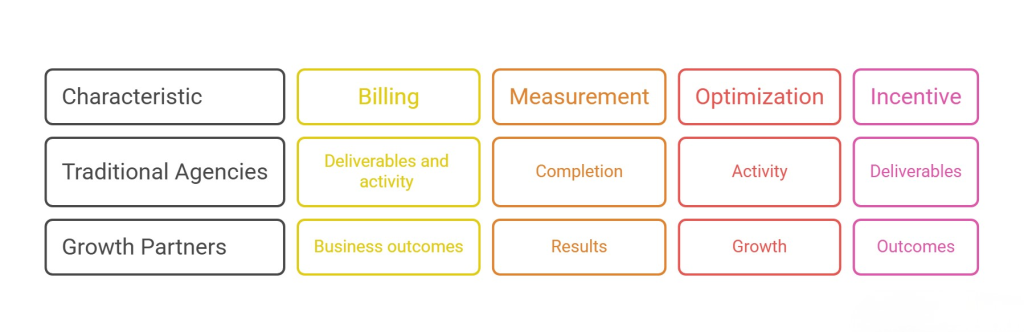
Core difference: Agencies measure completion (did we deliver the website?). Growth partners measure outcomes (did revenue increase?). One optimizes for keeping you dependent. The other succeeds only when you grow.
The average agency-client relationship lasts 3.2 years. The best ones last 22 years.
That gap tells you everything about what’s broken.
I’ve worked with businesses that cycled through agencies for years. They’d hire someone, run campaigns for six months, see mediocre results, then move to the next agency hoping for something different. The pattern repeated until they realized the problem wasn’t the agencies themselves.
The problem was the model.
Why Agency Economics Work Against You
Traditional agencies operate on volume. They sell services, bill hours, move to the next project. Revenue depends on keeping clients coming back for more work.
This creates tension.
When an agency’s income depends on you needing them next month, they’re not incentivized to solve your problems permanently. They’re incentivized to keep you dependent. Not through malice… through basic economics.
Research on digital advertising shows how this plays out. Ad platforms and agencies targeted consumers with higher probability of buying, not consumers who were more receptive to ads. The strategy looked good on paper but led to profit losses for the businesses paying for it.
The agency hit their metrics. The client didn’t grow.
Key insight: Agency incentives aren’t aligned with your growth. They’re aligned with their billing model.
How The Deliverable Trap Works
Traditional agencies focus on deliverables. They promise 12 social posts, a new website, or a certain number of ads. If they deliver those things on time, they call the work successful.
Whether those deliverables produced $0 or $100,000 in revenue doesn’t change their definition of success.
This is the deliverable trap. You’re paying for activity, not outcomes. The agency measures completion. You measure growth. Those are different things.
I’ve seen businesses spend six months getting a new website built, launch it, and watch nothing change. The agency delivered exactly what was promised. The business still isn’t growing. Both parties fulfilled their end of the agreement, but the fundamental problem stayed unsolved.
The issue isn’t bad work. Completing a deliverable doesn’t equal solving a business problem.
Key insight: Deliverables measure activity. Outcomes measure whether your business actually moved forward.
Why Agencies Always Say Yes
When a client says “I need Facebook ads,” the agency says yes. When the client says “I need a new website,” the agency says yes. Content marketing, email campaigns, SEO work… the answer is always yes.
This seems like good customer service. It’s a structural problem.
Agencies are economically pressured to be agreeable. If they challenge a client’s request or suggest the client is solving the wrong problem, they risk losing the revenue. It’s safer to execute what’s asked for, deliver it on time, and let the client figure out if it worked.
Over 82% of brands now have in-house agencies, and 65% have moved work away from external agencies. The most frequent issue cited is “a lack of clear understanding between both parties about expectations.”
Translation: agencies kept saying yes to things that didn’t work.
Key insight: When an agency’s revenue depends on your approval, they’re incentivized to agree with you… even when you’re wrong.
The Knowledge Transfer Problem
Traditional agencies protect their processes. They have proprietary systems, specialized tools, and methods they don’t share with clients. This makes sense from their perspective. If they transfer all their knowledge to you, you don’t need them anymore.
This creates dependency.
You hire an agency to run your ads. They set everything up in their accounts, using their systems. Six months later, if you want to bring the work in-house or switch agencies, you’re starting from scratch. All the learning, all the optimization, all the data stays with them.
You paid for the work. You don’t own the capability.
A growth partner operates differently. Their success depends on your business growing, which means they need you to get stronger. They transfer knowledge because your internal capability is part of the outcome they’re measured on.
When you eventually run things without them, that’s not a failure. It’s proof the partnership worked.
Key insight: Agencies profit from your dependency. Growth partners profit from your capability.
What Actually Separates The Two Models
The difference between a traditional agency and a growth partner isn’t about tactics or tools. It’s about how success is defined.
Traditional agencies measure completion. Did we deliver the website? Did we run the ads? Did we create the content? If yes, the work is done.
Growth partners measure outcomes. Did revenue increase? Did customer acquisition costs go down? Did the business grow? If no, the work isn’t done.
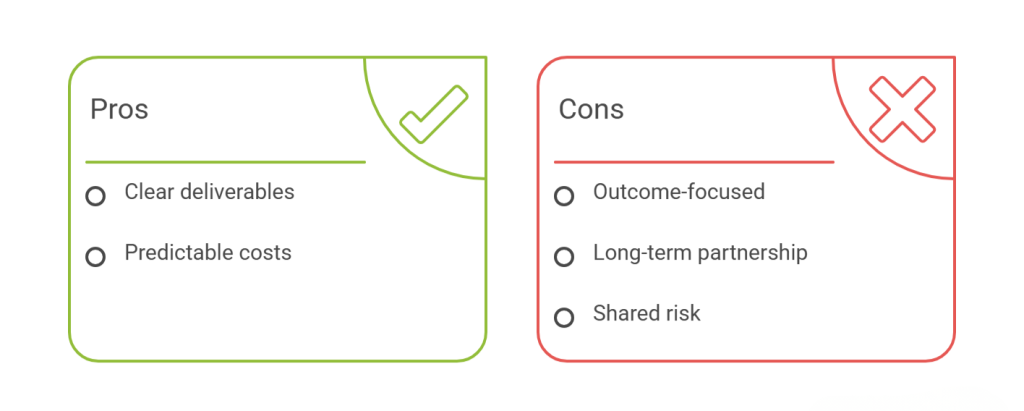
This changes how the relationship works.
When I work with a client, I don’t execute their plan and move on. I stay involved long enough to see if it’s producing results. If something isn’t working, I figure out why and adjust. I don’t point to a list of completed deliverables and call it success.
This also means I’m selective about what I work on. If I don’t think something will move the needle, I won’t do it… even if the client wants it. Because I’m measured on whether the business grew, not whether I was agreeable.
Key insight: Agencies optimize for client satisfaction. Growth partners optimize for client results. Those aren’t always the same thing.
Why The Diagnostic Phase Matters
Traditional agencies jump straight into execution. You tell them what you want, they give you a proposal, and work starts immediately. This feels efficient.
It’s where most failures begin.
When I start working with a client, the first thing I do is diagnostic work. I’m not running ads or building websites yet. I’m asking questions, looking at their systems, identifying what’s broken.
Clients get anxious during this phase. They’re paying me, but they’re not seeing immediate activity. They’re conditioned to equate activity with progress.
But diagnostic work is prevention. I’m making sure we don’t waste the next six months solving the wrong problem. Once we finish the diagnostic phase, execution becomes faster and more effective because we know what will work.
Traditional agencies skip this because it’s not billable in the same way. They’re selling 12 social posts, not 12 diagnostic sessions. The economic model doesn’t support it.
Key insight: Diagnosing the right problem takes time but saves months of wasted execution.
When The Traditional Model Becomes Dangerous
Early-stage businesses work fine with traditional agencies. When you need someone to execute a clear task, the agency model works.
The model becomes dangerous when your business reaches a certain complexity.
When you have multiple channels, when your customer journey has several touchpoints, when your internal processes need to scale… the traditional agency model starts creating more problems than it solves.
You end up working with multiple agencies at once. Two-thirds of brands now work with three or more digital agencies simultaneously. Each agency optimizes for their piece, but no one is looking at the whole system.
Your Facebook ads agency is driving traffic. Your website agency built a site that looks good but doesn’t convert. Your email agency is sending campaigns to a list that isn’t engaged. Each agency hit their metrics. Your business isn’t growing.
This is when businesses realize they don’t need more execution. They need someone who sees the whole picture and fixes what’s broken.
Key insight: Multiple agencies optimizing separate pieces often creates a system that doesn’t work as a whole.
What You Should Do About This
If you’re working with a traditional agency and getting results, don’t change anything. The model works for certain situations.
But if you’re cycling through agencies, if you’re adding tactics without seeing growth, if you feel like you’re paying for activity instead of outcomes… the problem isn’t the specific agency you hired.
It’s the model.
A growth partner costs more upfront. The diagnostic phase feels slow. You’ll be challenged on things you thought you knew. It’s uncomfortable.
But the alternative is spending years and tens of thousands of dollars on deliverables that don’t move your business forward.
The question isn’t whether you need a growth partner. It’s whether you’re at the stage where the traditional agency model is holding you back.
Most businesses figure this out after they’ve wasted the time and money. The ones that figure it out earlier are the ones that scale.
Look at how you’re currently buying marketing help. If you’re paying for deliverables and hoping they produce growth, you’re in the wrong model. If you’re working with someone who ties their success directly to your business outcomes, you’re in the right one.
Stop paying for activity. Start paying for results.
That is the model behind ONE: one team across marketing, sales, operations, and development.
Common Questions About Growth Partners vs Agencies
How do I know if I need a growth partner or if a traditional agency is fine?
If you have a clear, simple task and you know exactly what needs to be done, a traditional agency works. If you’re not seeing growth despite running campaigns, if you’re unclear what’s actually broken, or if you have multiple channels that need to work together, you need a growth partner.
Why do growth partners cost more upfront?
Because they spend time diagnosing what’s actually broken before executing anything. Traditional agencies skip this phase and jump straight into billable work. The diagnostic phase prevents wasted execution, but it takes time and expertise.
What happens if I hire a growth partner and they don’t produce results?
That’s the whole point of the model. If they don’t produce results, the partnership ends. Growth partners tie their success to your outcomes, so they have to deliver or they lose the relationship. Traditional agencies get paid regardless of whether your business grows.
Are all agencies bad and all growth partners good?
No. Some traditional agencies do excellent work for specific tasks. Some people calling themselves growth partners are just agencies with better marketing. The difference is in how success is measured and whether knowledge is transferred or protected.
How long does the diagnostic phase typically take?
It depends on the complexity of your business. For some companies, it’s two weeks. For others, it’s two months. The point isn’t speed during this phase. It’s accuracy. Getting the diagnosis right determines whether the next six months of execution works or wastes money.
Do I still need internal marketing if I hire a growth partner?
Yes. Growth partners build your internal capability over time. They’re not replacing your team forever. They’re working with your team to build systems and transfer knowledge so you get stronger. Traditional agencies often work around your internal team.
What if I’ve already been working with an agency for months?
Look at the results. If you’re growing and the relationship is working, stay. If you’re getting deliverables but not growth, you’re in the deliverable trap. The longer you wait to switch models, the more time and money you waste.
How do I tell if someone is a real growth partner or just marketing themselves that way?
Ask how they measure success. If they talk about deliverables, timelines, and activity, they’re an agency. If they talk about revenue, conversion rates, and business outcomes, and if they’re willing to tie their compensation to those outcomes, they’re a growth partner.
Key Takeaways
-
Traditional agencies optimize for deliverables and billable hours. Growth partners optimize for your business outcomes. The economic incentives are fundamentally different.
-
Agencies are incentivized to keep you dependent because their revenue relies on you needing them. Growth partners succeed when you build capability and grow.
-
The deliverable trap: paying for activity (12 social posts, a new website) doesn’t equal paying for growth. Completion doesn’t mean the business problem got solved.
-
Agencies say yes to everything because challenging your plan risks losing revenue. Growth partners say no when something won’t work because they’re measured on results, not agreeability.
-
The diagnostic phase feels slow but prevents months of wasted execution. Agencies skip it because it’s not billable. Growth partners require it because solving the wrong problem is expensive.
-
The traditional agency model becomes dangerous at a certain business complexity. When you have multiple channels and touchpoints, having separate agencies optimize individual pieces creates a system that doesn’t work as a whole.
-
If you’re cycling through agencies without seeing growth, the problem isn’t the specific agency. It’s the model. Stop paying for activity. Start paying for results.