




The leads you’re looking for won’t come unless you address these seven priorities:
-
Fix your positioning before you promote anything
-
Define a specific audience profile, not broad categories
-
Build a pre-qualification system to filter out tire-kickers
-
Run targeted campaigns to people who match your profile
-
Track everything and optimize based on data
-
Start marketing three to six months before you need customers
-
Build trust through proof points and case studies
You’r e spending money on ads. You’re posting on social media. You’re updating your website.
But the leads aren’t coming. Or worse, they’re coming but they’re terrible.
I’ve watched businesses across industries make the same mistake over and over. They jump straight to tactics without fixing what’s broken underneath.
The problem isn’t your ads. The problem is your foundation.
Why Lead Generation Fails Before It Starts
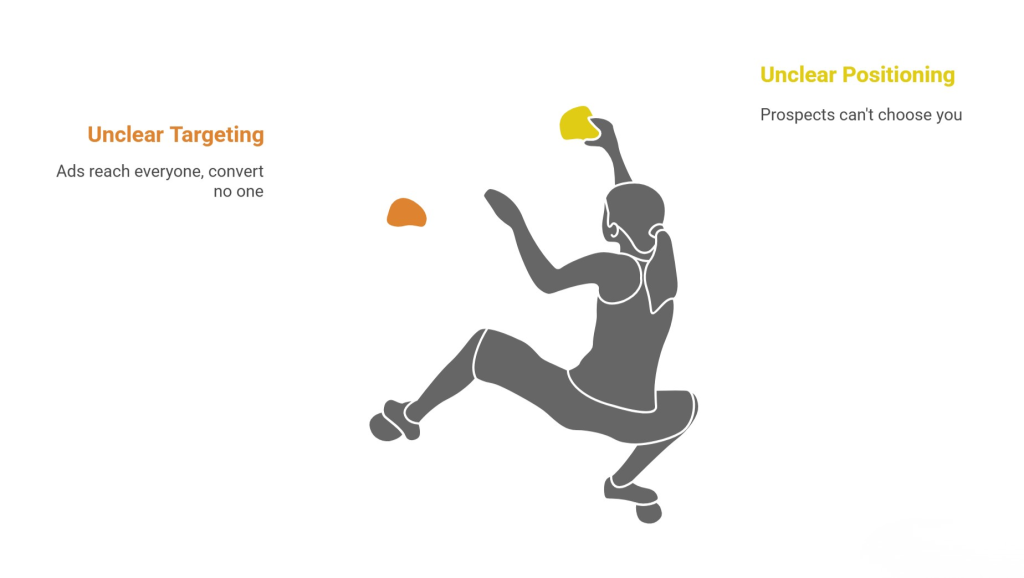
Businesses struggle with low lead-to-MQL conversion rates because they focus on tactics before foundation. When you don’t know who you’re targeting, your ads reach everyone and convert no one. When your positioning is unclear, prospects can’t tell why they should choose you over any competitor in the market.
I worked with a wood framing company with this exact issue. They had skilled tradespeople. They delivered quality work. Nobody knew they existed.
They relied entirely on personal connections for work. When those connections dried up, so did the projects. Workflow was unpredictable. Anxiety was constant.
The real issue wasn’t marketing. The issue was positioning.
Businesses in their category look identical in the marketplace. Generic messaging. No clear differentiation.
This company had zero marketplace awareness. Potential clients didn’t know what made them different. The owners couldn’t articulate their unique value.
Beautiful websites and clever ads don’t work when your foundation is broken. You need to fix the roots first.
What Is Positioning and Why It Matters
Positioning answers two questions: Who is your ideal customer? How do you communicate with them?
Take the wood framing company as an example. We started with deep market research. We studied their competitors. We identified the gaps. We discovered what their clients needed, not what they said they wanted.
We developed messaging that positioned them as strategic partners, not service providers.
The shift was simple. Instead of “crew for hire,” they became the framing company that understood project timelines, quality standards, and client needs.
This clarity changed everything. Within one year, they went from invisible to fully booked. They tripled crew size to meet demand. Clients across the region now recognize them as leaders.
Positioning matters more than promotion. When your ideal customers understand what makes you different, they choose you over competitors.
Steps to fix your positioning:
-
Conduct market research to understand your competitive space
-
Identify gaps between what your audience needs and what competitors deliver
-
Develop messaging that speaks to those gaps
-
Test your positioning with real prospects before scaling promotion
Bottom line: You need clear positioning before you spend a dollar on ads. Promotion without positioning wastes your budget reaching people who won’t convert.
How to Define Your Specific Audience Profile
You need to know exactly who wants to work with you. Not “small businesses” or “enterprise clients.” Those labels are too broad to build marketing around.
Get specific. What’s their budget range? What do they need from you? What’s their timeline?
This specificity becomes critical when timing matters. In multi-family property development, the average cost of resident turnover ranges between $3,000 and $5,000 per unit. Waiting until construction finishes to find tenants costs serious revenue.
Waiting to attract customers until you need them creates pressure and lost opportunity.
One of our clients understood this. They defined their ideal tenant profile before running a single ad. This clarity shaped everything: which platforms to use, which features to highlight, which questions to ask during pre-qualification.
When your audience profile is vague, your marketing becomes generic. When it’s specific, your messaging gets sharp.
Steps to define your audience:
-
Document your ideal customer’s budget range, timeline, and must-haves
-
Identify where they spend time online and offline
-
Understand their decision-making process and pain points
-
Create messaging that speaks directly to their situation
Bottom line: Specific audience profiles lead to specific messaging. Generic profiles lead to generic marketing that reaches everyone and converts no one.
How Pre-Qualification Systems Filter Out Bad Leads
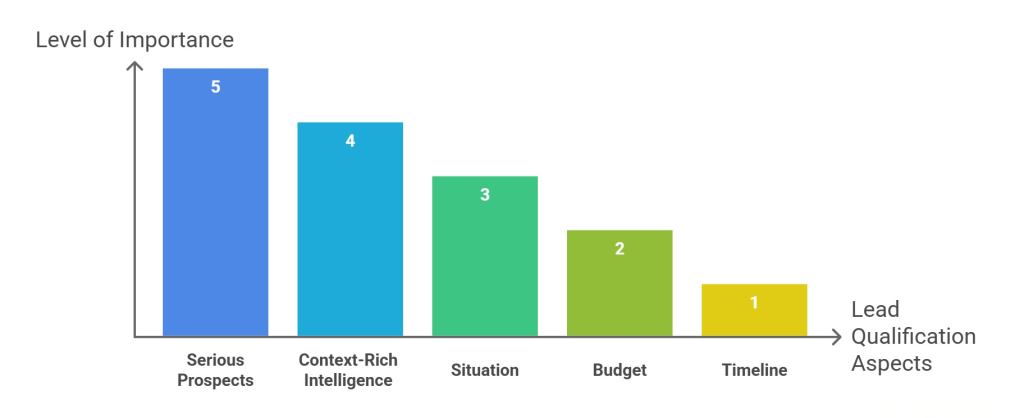
You filter leads before they waste your time. A qualification system separates serious prospects from people browsing with no intent to buy.
Ask the right questions upfront. Budget. Timeline. Must-haves. You’ll learn fast who’s ready to commit and who’s exploring options.
This isn’t about being aggressive. It’s about respecting time. If someone’s budget doesn’t align with your pricing, or their needs don’t match your offering, you both need to know early.
This client set up pre-qualification questions before prospects spoke with anyone on the team. Sales conversations only happened with people who met the basic criteria.
Companies excelling at lead nurturing generate 50% more sales-ready leads at 33% lower cost.
Pre-qualification protects your team’s time and improves conversion rates because you’re only talking to qualified prospects.
In complex sales, a good lead isn’t contact information. It’s context-rich intelligence. You need to understand their situation, budget, timeline, and requirements. Pre-qualification helps you gather this intelligence systematically.
Steps to build pre-qualification:
-
Create a qualification checklist with budget, timeline, and project requirements
-
Automate initial qualification through forms or chatbots
-
Train your team to ask qualifying questions early in conversations
-
Document why leads don’t qualify to refine your targeting
Bottom line: Pre-qualification separates serious buyers from tire-kickers. This protects your team’s time and improves your conversion rates because every conversation is with someone who meets your minimum criteria.
How to Run Targeted Campaigns That Reach the Right People
You run ads to people who match your audience profile. Not everyone. The ones who fit.
The average website conversion rate across industries hovers around 2 to 3%. Without proper positioning and targeted messaging, businesses waste 97 to 98% of their traffic.
This client focused on design and lifestyle aspects their specific audience cared about. They didn’t create generic property ads. They spoke directly to the priorities their research uncovered.
Broad advertising feels safer because it reaches more people. Targeted advertising works better because it reaches the right people.
When you’re clear on who you’re building for, you know which platforms they use, which messaging resonates, and which features matter to them.
Word-of-mouth and client referrals achieve higher lead-to-MQL conversion than paid advertising.
This shows trust-based positioning and strategic differentiation outperform generic marketing in business-to-business contexts.
Steps for targeted campaigns:
-
Start with small test budgets on multiple platforms
-
Create ad variations that speak to different pain points
-
Use platform targeting to reach your specific audience profile
-
Focus on one clear call-to-action per campaign
Bottom line: Targeted campaigns to a specific audience profile outperform broad campaigns every time. You’re not trying to reach more people. You’re trying to reach the right people.
Why Tracking and Data Optimization Beat Guesswork
You measure cost per lead, conversion rates, and where your best clients come from. This tells you what’s working.
When you know your numbers, you scale what works and cut what doesn’t. No guessing.
This client tracked every lead source and calculated the cost to acquire each qualified prospect. The data showed them which channels produced quality leads and which ones drained budget without results.
Responding within the first hour multiplies qualification odds by 7x.
This demonstrates systematic response frameworks and pre-qualification systems create measurable advantages in lead conversion.
Businesses treat lead generation as an art. It’s not. It’s a system with measurable inputs and outputs.
Tracking creates feedback loops that let you optimize spending and improve results continuously. Without tracking, you’re flying blind.
Steps to track and optimize:
-
Set up tracking for every lead source (ads, referrals, website, events)
-
Calculate cost per lead and cost per qualified lead separately
-
Track conversion rates at each stage of your process
-
Review data weekly and adjust spending based on performance
Bottom line: Lead generation is a system with measurable inputs and outputs. Tracking creates feedback loops that let you cut what doesn’t work and scale what does.
Why You Should Start Marketing Before You Need Customers
Waiting until you desperately need customers puts you in a weak position. You make poor decisions under pressure. You accept bad-fit clients. You discount when you shouldn’t.
Building your lead generation system before urgency hits solves this. You’re not adding complexity. You’re shifting when the work happens.
In multi-family development, this principle shows up clearly. One of our clients started tenant acquisition months before construction finished. By completion day, they had 90% occupancy.
The sequence they followed:
-
Defined their ideal customer profile early in the process
-
Built pre-qualification questions into their inquiry process
-
Launched targeted ads highlighting the features their audience cared about
-
Tracked cost per lead and conversion rates weekly
-
Adjusted ad spend based on performance data
By the time they needed customers, they’d built a pipeline of qualified prospects. No scrambling. No revenue gap. No discounting to close deals fast.
Proactive lead generation beats reactive scrambling every time.
The difference between building your system early versus waiting until you need it is measured in lost revenue and weakened negotiating position.
Steps to start early:
-
Start building your lead generation system three to six months before you need customers
-
Build a waitlist or pipeline of pre-qualified prospects
-
Create marketing assets that showcase your offering before launch
-
Offer early-adopter incentives for customers who commit before your busy season
Bottom line: Building your lead system before you need it protects you from making poor decisions under pressure. You won’t accept bad-fit clients or discount when you shouldn’t because you have options.
How to Build Trust Through Proof Points
Only 25% of marketing leads advance to sales teams. That’s a 75% qualification failure rate.
Trust elements and proof points on your website help prospects know you’re credible and you’ve delivered results for people like them.
You need testimonials from clients who match your ideal customer profile. You need case studies that show specific results. You need credentials that matter to your audience.
The wood framing company built trust through regional recognition. Their target clients started seeing them as established leaders, not another option.
Average B2B conversion rates sit at 3.6% across industries.
Professional services achieve 12.3% while other sectors see lower rates. Strategic positioning and market clarity impact conversion performance regardless of tactics deployed.
Steps to build trust:
-
Collect testimonials that speak to specific pain points you solve
-
Document case studies with measurable results
-
Display relevant certifications and industry affiliations
-
Show photos or videos of completed projects
Bottom line: Proof points filter out unqualified prospects and attract qualified ones. When you show testimonials and case studies from clients who match your ideal profile, the right prospects recognize themselves in those stories.
Common Mistakes That Kill Lead Quality
Jumping straight to ads without positioning. You’ll waste money reaching the wrong people with unclear messaging.
Targeting too broadly. “All small businesses” or “anyone who needs our service” won’t give you the specificity needed for effective campaigns.
Skipping pre-qualification. Your team will spend time on unqualified leads while qualified prospects wait.
Not tracking performance. You can’t optimize what you don’t measure. Lack of tracking causes wasted spend and missed opportunities.
Starting marketing too late. Waiting until you urgently need customers creates pressure and lost opportunity you can’t recover.
Competing on price alone. If you’re competing on price, you can’t grow a business. Differentiation matters more than discounting.
The pattern: Businesses skip foundation work because they want results fast. Then they spend months getting poor results from tactics that were never going to work without proper positioning.
What This Means for You
The businesses that invest in their foundation now win. Waiting for perfect timing means watching competitors take market share.
Fix your positioning first. Define your specific audience. Build a pre-qualification system. Run targeted campaigns. Track everything. Start early.
This isn’t about adding more tactics. It’s about building the right foundation so your tactics work.
One client went from invisible to industry leader in one year. Another reached 90% occupancy by opening day. Both followed the same sequence: foundation first, tactics second.
The cost of building this system is lower than the cost of scrambling for customers when you desperately need them.
Start with your foundation. Everything else follows.
Frequently Asked Questions
How long does it take to see results from these practices?
Results vary based on market conditions and current positioning. Some businesses see qualified leads within 60 to 90 days after launching targeted campaigns with proper positioning. Others with longer sales cycles see results within six to twelve months. The foundation work takes time upfront, but the results compound over time.
What’s the most important practice to start with?
Fix your positioning first. Without clear positioning, every other tactic becomes less effective. You need to know who you serve and what makes you different before you spend money on promotion. Positioning is the foundation everything else builds on.
How much should I budget for lead generation?
Strategic positioning and messaging work starts at $1,800 to $15,000. Ongoing marketing services range from $3,000 to $10,000 monthly depending on campaign complexity and market size. Track your cost per qualified lead to determine ROI. Budget allocation depends on your industry, deal size, and sales cycle length.
Can small businesses compete with larger firms using these practices?
Yes. Small businesses often benefit more because proper positioning helps them compete against larger firms. Clear differentiation matters more when you’re smaller. You can’t outspend big competitors, but you can out-position them. Positioning levels the playing field.
When should I start marketing if I have a launch or busy season coming up?
Start marketing three to six months before you need customers. This gives you enough time to attract, qualify, and convert prospects into committed clients by the time you need them. Starting earlier protects against revenue gaps and weak negotiating positions.
What if my market is too competitive for these practices to work?
Competitive markets make positioning even more critical. When everyone looks the same, differentiation becomes your advantage. The practices work better in competitive markets because competitors skip the foundation work. When they look identical, your clear positioning stands out.
How do I know if my pre-qualification questions are working?
Track the percentage of pre-qualified leads that convert to sales. If your conversion rate improves and your team spends less time on unqualified prospects, your questions are working. Adjust based on which questions best predict qualified leads. The data tells you what’s working.
Should I handle this in-house or hire outside help?
You need expertise in positioning and lead generation, whether internal or external. Businesses partner with marketing firms because they don’t have the capability in-house. The decision depends on your team’s skill set, available time, and whether building this capability internally makes strategic sense for your business.
Key Takeaways
-
Fix your positioning before spending money on promotion. Unclear positioning wastes 97 to 98% of your traffic.
-
Define your specific audience profile with budget range, timeline, and must-haves to create sharp messaging.
-
Build a pre-qualification system to filter leads before they waste your team’s time.
-
Run targeted campaigns to people who match your audience profile, not everyone.
-
Track cost per lead, conversion rates, and lead sources to optimize continuously.
-
Start marketing three to six months before you need customers to avoid scrambling under pressure.
-
Build trust through testimonials, case studies, and proof points that match your ideal customer.
-
Businesses excelling at lead nurturing generate 50% more sales-ready leads at 33% lower cost.
-
Word-of-mouth and referrals achieve higher conversion than paid advertising, proving positioning matters.
-
The cost of building these systems is lower than the cost of scrambling for customers when you desperately need them.