



Hybrid compensation models (small retainer plus performance upside) work best when agencies control all variables that drive outcomes. Pure performance pricing fails without full system authority. Pure retainers work for foundation building but lack outcome alignment. The real question isn’t which model to choose. It’s whether authority matches accountability.
What You Need to Know
-
Performance-only pricing breaks when agencies don’t control the offer, sales process, and customer touchpoints
-
Retainer-only models enable foundation work but weaken accountability for results
-
Hybrid structures (small base plus performance) align incentives when agencies have full system authority
-
Payment model matters less than clarity on work scope, timeline, and variable control
I’ve watched this pattern dozens of times.
Business owner meets with agency. Agency pitches performance-based pricing. “We only get paid when you get results.”
Sounds perfect. Aligned incentives. Shared risk. Skin in the game.
Six months later, it falls apart.
The problem isn’t the model. It’s that people don’t understand what they’re optimizing for when they choose how to pay for marketing work.
What Is Performance Pricing and How Does It Work?
The appeal is straightforward. You pay for outcomes, not activity. Agency has to deliver or they don’t get paid. Risk shifts from you to them.
Here’s what the pitch leaves out.
According to industry data, the typical performance model involves agencies sacrificing 10% of their profit for the chance to earn 10-15% back. That percentage gets calculated only on the retainer portion, which represents less than half of total agency revenue.
When you ask marketers if they’d accept this with their own salaries, the answer is no.
The math breaks because the agency doesn’t control enough variables. Economy shifts. Product supply changes. Competitor launches something new. Distribution breaks down. Agency gets blamed for outcomes they can’t influence.
This creates a predictable pattern. Revenue becomes unpredictable. Up one month, down the next. Agency invests in work, buys tools, walks away with little if results lag. They start optimizing for short-term wins they control instead of long-term foundation work.
What this means: Performance pricing fails when agencies lack control over the variables that drive results.
What Are Retainer Models and When Do They Work?
Retainers flip the equation. You pay a fixed amount each month. Agency gets predictable revenue. You get consistent access to their time and expertise.
The criticism is fair. Payments aren’t directly tied to outcomes. There’s less immediate accountability. If the agency lacks demonstrated expertise, you’re paying ongoing costs without measurable results.
Here’s where this misses the point. That’s a partner selection problem, not a model problem.
What retainers buy you is the ability to do foundation work. The kind of work that doesn’t show up in this month’s metrics but determines whether anything works six months from now.
Strategic positioning. Market research. System architecture. Message development. These take time. They require iteration. They don’t fit neatly into performance metrics.
When I work with businesses on retainer, we spend the first 30 to 60 days on work that looks like nothing is happening. We’re clarifying who they serve, what makes them different, and how their acquisition system should function. That work doesn’t generate leads this week. It determines whether leads convert next quarter.
Performance models punish this approach. Agency needs to show results fast, so they skip the foundation and jump straight to tactics. You get activity without strategy. Motion without direction.
The real benefit: Retainers enable the foundation work that determines whether tactics work at all.
When Does Performance Pricing Work vs Retainers?
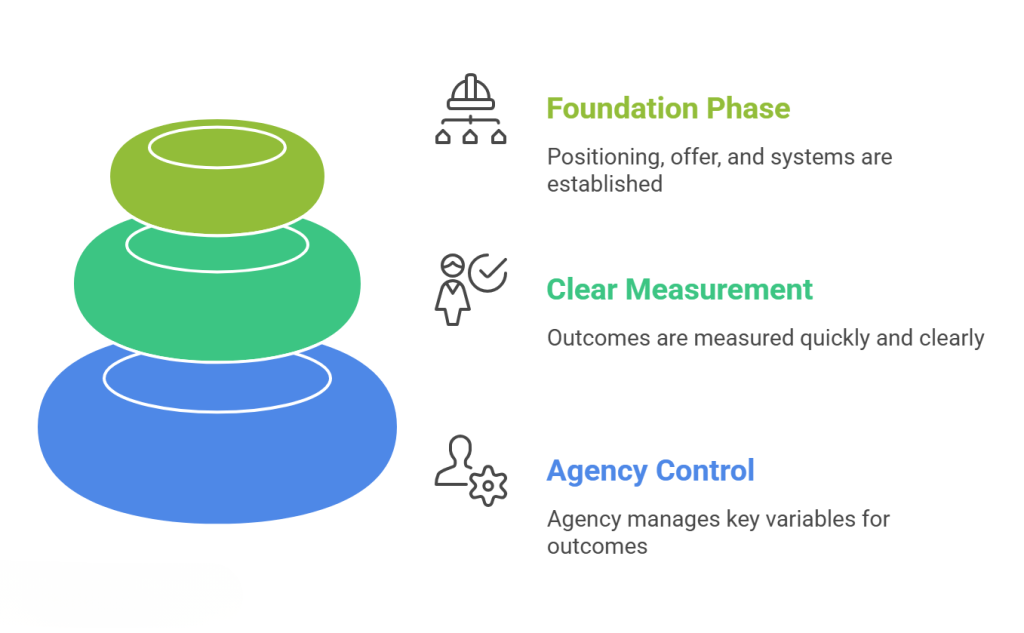
Performance pricing works when three conditions exist
First: The agency controls most of the variables that drive outcomes. If they’re running paid ads and you have a proven offer, solid product, and working fulfillment, they’re able to reasonably influence results.
Second: You measure outcomes clearly and quickly. Lead generation, appointment setting, and direct response campaigns fit this. Brand awareness and long-term positioning don’t.
Third: You’re past the foundation phase. Your positioning is clear. Your offer converts. Your systems work. You need someone to execute tactics at scale.
Retainers work when you need to build or rebuild foundations
When your positioning is weak. When your offer needs refinement. When you’re not sure what tactics will work because you haven’t clarified strategy yet.
They work when the relationship requires ongoing strategic thinking, not execution alone. When you need a partner who sees around corners, spots patterns, and adjusts course based on what they’re learning.
Key distinction: Match the model to the work phase. Foundation work needs retainer stability. Tactical execution with full variable control enables performance pricing.
Why Hybrid Compensation Models Work Best
The structure I prefer is straightforward: small base retainer plus performance-based upside.
The retainer covers foundation work. Positioning, strategy, system architecture. The performance component kicks in once we’re executing proven tactics.
This works when the agency controls the variables that drive outcomes. Not only ad execution, but the entire customer experience. The offer. The messaging. The sales process. Every touchpoint from first awareness to final conversion.
When we structure engagements this way, clients give us the authority to influence everything that affects results. We’re not running campaigns and hoping their funnel converts. We’re rebuilding the funnel, refining the offer, and optimizing the entire system.
That level of control changes the economics completely. Agency delivers outcomes because they control the variables. Client gets foundation work done without paying pure retainer rates. Both parties share upside when the system works.
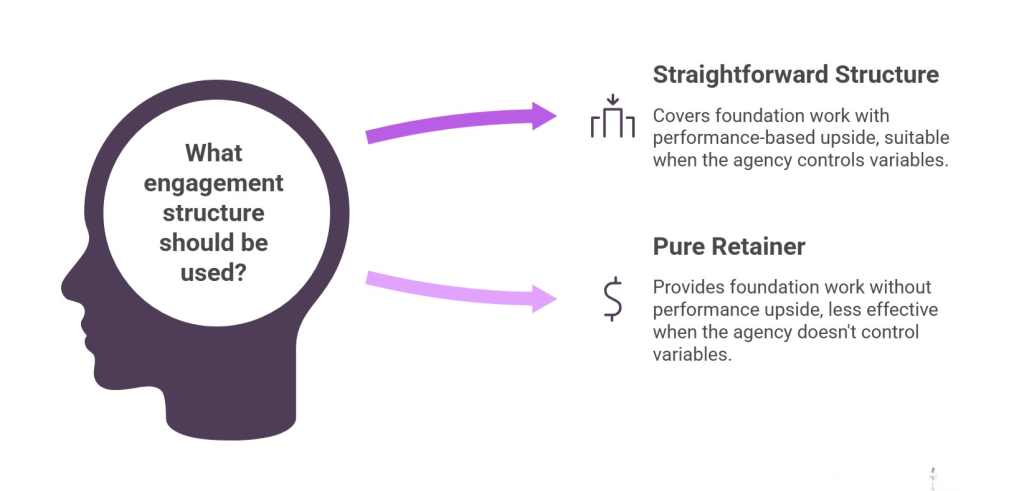
But if an agency can’t touch your offer, can’t influence your sales process, and can’t optimize customer touchpoints… if they’re running ads into your existing system… performance pricing breaks. You’re holding them accountable for outcomes they can’t control.
The advantage: Hybrid models align incentives when agencies have full system authority. Small retainer funds foundation work. Performance upside rewards results the agency controls.
What Matters More Than the Payment Model
I’ve seen both models work and fail. The pattern isn’t about the payment structure. It’s about whether the relationship has clarity on five things.
1. What work needs to happen: Foundation or execution. Strategy or tactics. Building or optimizing.
2. What outcomes you’re measuring: Not only “more leads” but specifically what success looks like and over what timeframe.
3. Who controls the variables: Agency can’t be accountable for things outside their influence. Your product quality, pricing, fulfillment, and sales process all affect outcomes.
4. How long the work takes: Foundation work needs months. Tactical execution shows results in weeks. Payment model should match the timeline.
5. What happens when things don’t work: Not if, when. Every engagement hits obstacles. How you handle them matters more than how you structured payment.
When these five things are clear, the payment model becomes a detail. When they’re not, no payment structure fixes the underlying misalignment.
Core principle: Relationship clarity determines success more than compensation structure.
How to Choose the Right Compensation Model
Don’t start with “Should we do performance or retainer?”
Start with “What level of control will the agency have?”
If you’re willing to give an agency authority over your positioning, offer, messaging, sales process, and customer touchpoints… if you’re open to letting them rebuild the system, not only run campaigns… then a hybrid model with heavy performance weighting makes sense.
The small retainer covers the foundation work. The performance component rewards outcomes the agency controls because they’re touching everything that drives those outcomes.
But if you want to keep your offer, sales process, and funnel exactly as they are… if you’re hiring someone to drive traffic into an existing system… don’t pretend performance pricing will work. Agency can’t be accountable for conversion problems they’re not allowed to fix.
Here’s what I’ve observed: agencies fail at performance pricing because they don’t have enough control. Clients fail because they don’t give enough control.
The model that works is the one where authority matches accountability.
Give your agency the ability to influence outcomes, then tie their compensation to those outcomes.
Common Questions About Agency Compensation Models
What’s the difference between performance-based and retainer pricing?
Performance-based pricing ties agency compensation to measurable outcomes like leads, sales, or revenue. Retainer pricing provides fixed monthly payment for ongoing access to agency services and expertise. Performance shifts risk to the agency. Retainer provides predictable costs and enables foundation work.
Why do performance-based models often fail?
They fail when agencies don’t control enough variables that drive outcomes. If the agency runs ads but can’t touch your offer, sales process, or customer experience, they get blamed for results outside their influence. The math breaks and relationships collapse.
When should I choose a retainer over performance pricing?
Choose retainer when you need foundation work. When your positioning is unclear, your offer needs refinement, or your acquisition system needs building from scratch. Foundation work takes time and doesn’t fit neatly into performance metrics.
What makes hybrid models work better than pure models?
Hybrid models (small retainer plus performance upside) work when agencies have full system authority. The retainer funds foundation work. Performance rewards outcomes the agency controls. Both parties share risk and upside. This only works with complete variable control.
How much control should I give an agency for performance pricing to work?
Agency needs authority over positioning, offer, messaging, sales process, and all customer touchpoints. Not only ad execution. They need to rebuild the system, not run campaigns into your existing funnel. Without full control, performance pricing sets everyone up to fail.
What if my agency wants performance-only pricing with no retainer?
Be skeptical. Pure performance models create incentive problems. Agency optimizes for short-term wins they control, skipping foundation work that determines long-term success. They’re taking significant financial risk without funding to do proper strategic work.
How long does foundation work typically take before performance tactics begin?
Foundation work typically takes 30 to 90 days. You’re clarifying positioning, refining offers, building system architecture, and developing messaging. This work doesn’t generate immediate leads but determines whether tactics work at all. Performance metrics become meaningful after foundations are solid.
What’s more important than the payment model itself?
Clarity on five things matters more: what work needs to happen, what outcomes you’re measuring, who controls the variables, how long the work takes, and what happens when obstacles emerge. When these are clear, payment model becomes a detail.
Key Takeaways
-
Hybrid compensation models (small retainer plus performance) work best when agencies control all variables: offer, sales process, messaging, and customer touchpoints
-
Pure performance pricing fails when agencies lack system authority and get blamed for outcomes they can’t influence
-
Retainer models enable critical foundation work that doesn’t show immediate results but determines long-term success
-
The payment model matters less than relationship clarity on work scope, outcome measurement, variable control, timeline, and obstacle handling
-
Authority must match accountability. Give agencies control over what drives outcomes, then tie compensation to those outcomes
-
Foundation work typically requires 30 to 90 days before performance tactics show measurable results
-
Choose based on your phase: foundation building needs retainer stability, tactical execution with full control enables performance pricing