



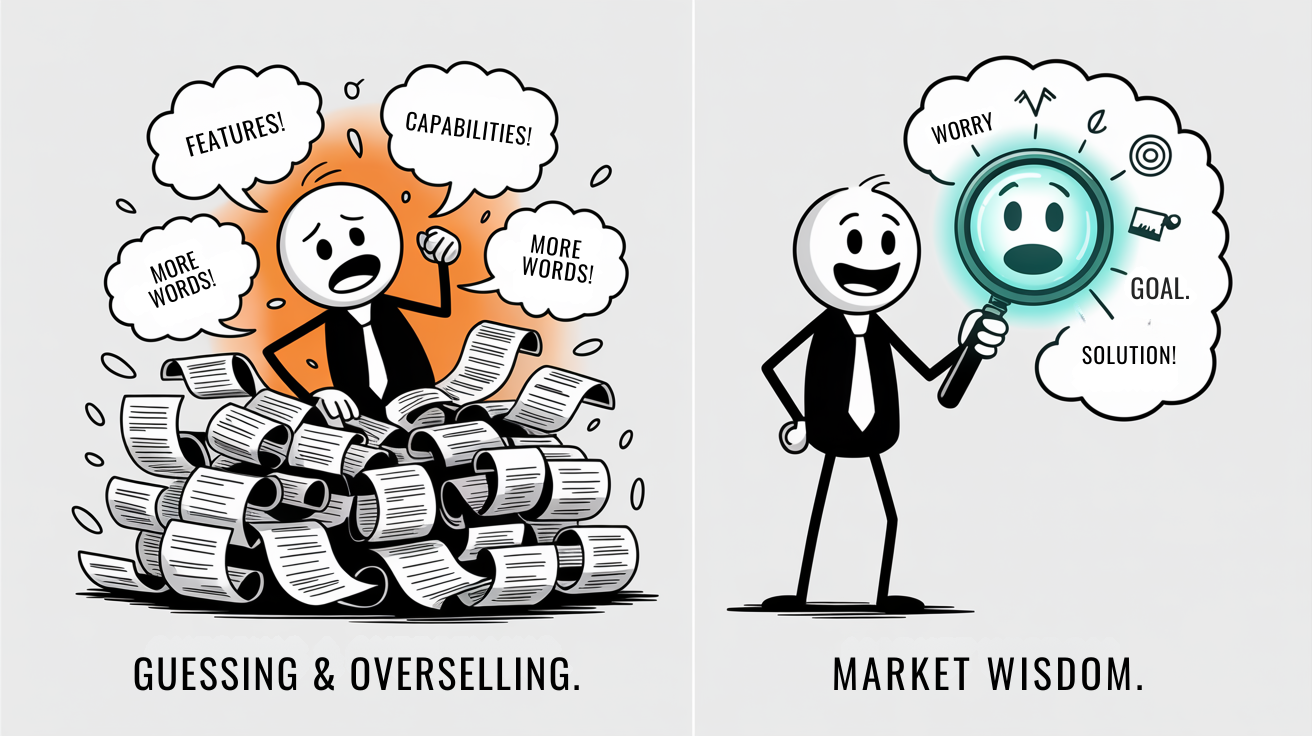
Businesses drowning in feature lists are compensating for missing customer intelligence. When you deeply understand your customers and master your craft, you don’t oversell. You speak directly to their fears and desires, becoming the obvious choice through insight instead of explanation.
Core Answer:
-
Businesses that over-explain lack customer intelligence and core competency
-
Customer intelligence means understanding unspoken fears, desires, and objections
-
Market wisdom comes from research, not guesswork, and competitors can’t copy it
-
Deep customer understanding makes you predictive instead of reactive
-
Real confidence shows up as quiet certainty, not loud feature lists
You’ve seen them. The businesses that drown you in feature lists and capability explanations.
They’re showing you something important.
What you lack in substance, you make up in words.
When you truly understand your customers and know your craft, overselling isn’t necessary.
Right now, most service businesses are stuck repeating the same cycle. They launch ads, the ads don’t work, so they launch more ads expecting different results. They’re guessing what their customers want instead of researching and building a real ideal customer profile.
Why Guessing Instead of Researching Kills Your Positioning
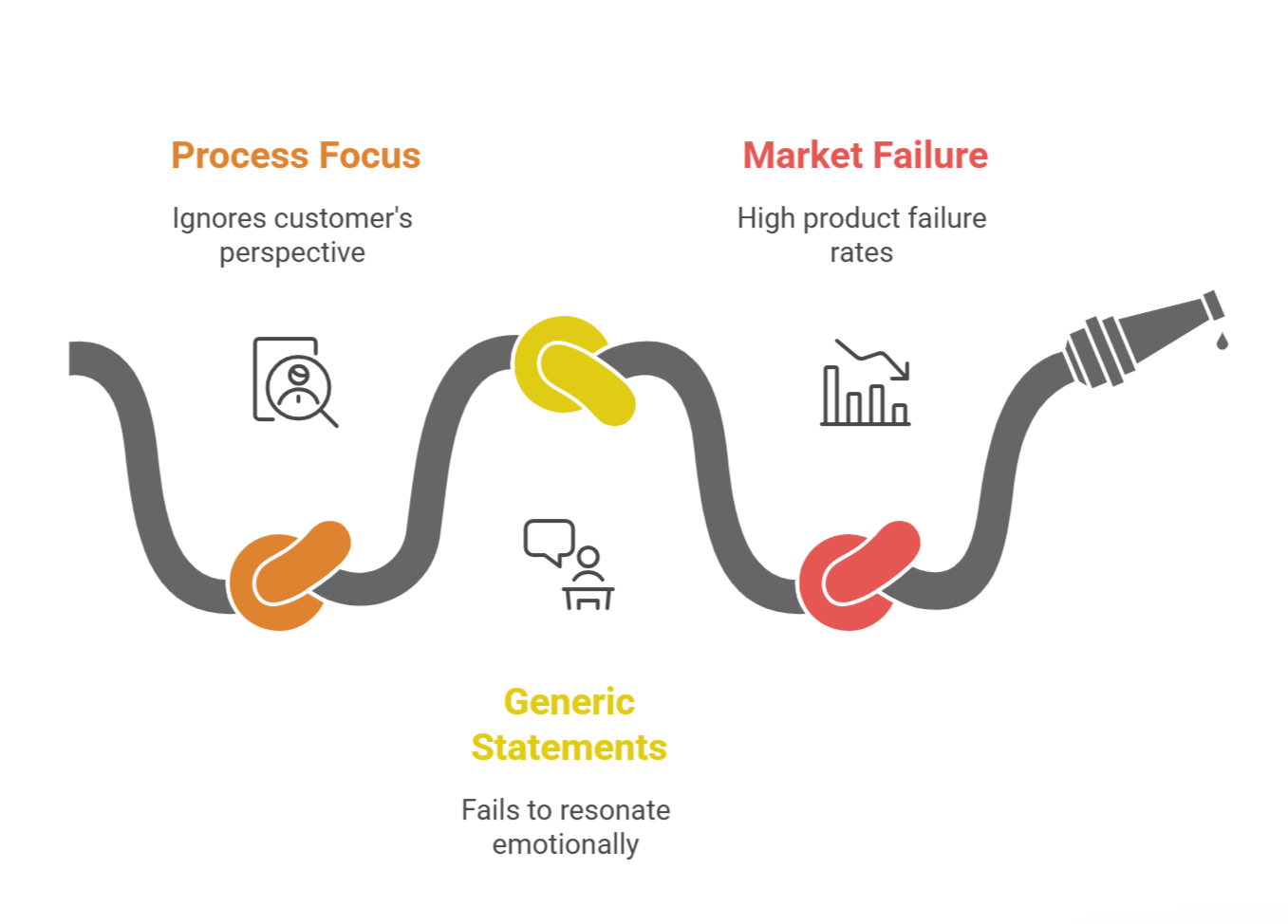
When you guess, you talk about your process instead of your customer’s reality.
You say “we do consulting” or “we build websites” while your prospects are thinking “I’m tired of throwing money at strategies that don’t work because I don’t know why someone would choose me over the competitor down the street.”
One talks about what they do. The other addresses what the customer experiences.
The product failure rate proves this point. 30 to 40% of products reaching market fail. Some industries see failure rates between 85 and 95% in the first two years.
The root cause? Businesses build what they think customers want instead of what customers need.
Bottom line: Guessing makes you talk about yourself. Research makes you talk about them.
What Customer Intelligence Actually Means
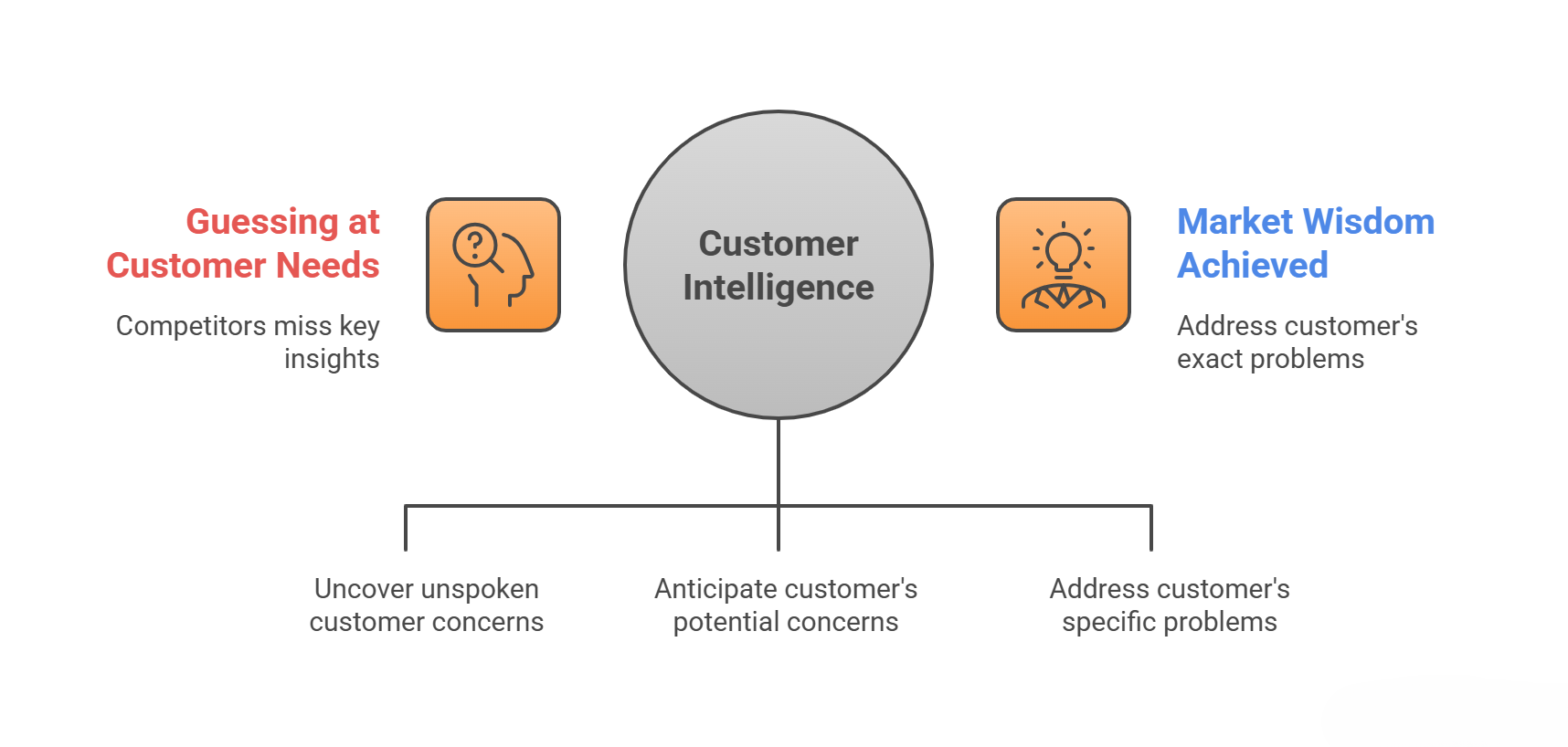
Customer intelligence means you stop guessing and start researching.
When you do this right, you uncover something competitors miss entirely.
Fears, desires, hopes, and dreams your prospects never say out loud.
You learn the exact conversation happening in their head. The three objections they’ll raise before they voice them. The failed attempts that made them skeptical.
This creates market wisdom. Something you can’t fake or buy with a bigger ad budget.
While competitors list features and capabilities, you’re addressing the problems keeping prospects up at night. You speak their internal language.
When you position around customer intelligence, you show market wisdom competitors can’t replicate because it’s built on genuine insight, not better marketing copy.
Competitors copy your services, but they can’t copy years of understanding what drives customer decisions in your market.
The shift: Customer intelligence turns you from one option into the obvious choice.
How Market Wisdom Changes What Your Customers Say About You
When you get customer intelligence right, your market notices immediately.
Your messaging stops sounding like everyone else’s. Instead of generic promises, you speak to specific situations with surgical precision.
Prospects go from saying “let me think about it” to “this is exactly what I’ve been looking for.”
Your referrals transform too.
Before: “They do good work.”
After: “They understand our industry like no one else” or “They knew what we needed before we did.”
The market starts seeing you as the specialist who gets it, not another service provider trying to win business. Authority builds naturally because you’re showing insight, not capability.
The numbers back this up. The customer intelligence platform market is growing at 28.3% annually, projected to hit $13.18 billion by 2030.
Why? Because customer experience drives buying decisions. 86% of buyers will pay more for better customer experience.
What this means for you: Deep customer understanding turns into premium pricing and inbound leads.
How Businesses With Customer Intelligence Operate Differently
Businesses with real customer intelligence don’t operate like their competitors.
They’re predictive, not reactive.
When a prospect calls, they already know the objections coming. Sales conversations feel like mind-reading because they’ve researched the customer journey.
They don’t need to explain much. They’re addressing problems customers didn’t even realize they’d articulated.
Here’s what this looks like in practice:
They’ll say things like “I bet you’ve tried X approach before and it didn’t work because of Y.” The prospect thinks “how did they know?”
Their content, messaging, and service delivery all center on customer reality, not internal processes.
While competitors post about their latest certification or new service offering, the market-wise business shares insights about industry challenges that make prospects think “finally, someone who gets it.”
They become the go-to resource before they become the go-to provider.
The pattern: Understanding first, transaction second.
What Quiet Certainty Looks Like When You Combine Competency and Customer Intelligence
When you have both competency and customer intelligence working together, confidence looks different.
Quiet certainty.
You’re not chasing prospects. They’re coming to you because your reputation goes ahead of you.
Your conversations are consultative, not sales-heavy. You’re selective about who you work with because you know your value and you know exactly who needs what you offer.
You speak in outcomes, not outputs.
Instead of “we’ll create a marketing strategy,” you say “we’ll solve the lead generation problem keeping you stuck at your current revenue level.”
You’re direct about what won’t work and why, because you’ve seen it before. Prospects trust your judgment because you show market wisdom they can’t get anywhere else.
You stop competing on price or features. You compete on insight and results.
You become the obvious choice, not because you’re the cheapest or have the most services, but because you understand their world better than anyone else and you deliver what matters to them.
Business becomes predictable instead of a constant hustle.
Your customers aren’t buying what you’re selling. They’re buying the feeling of being understood by someone who’s seen their exact situation before and knows how to deliver the solution they need.
The result: You attract the right clients who value your wisdom, not your word count.
Frequently Asked Questions
What is customer intelligence in business?
Customer intelligence is deep understanding of your prospects’ unspoken fears, desires, hopes, and objections. It comes from research, not guesswork, and allows you to address customer problems before they articulate them.
How do I know if I’m guessing instead of using customer intelligence?
You’re guessing if you talk about your process and capabilities instead of your customer’s specific problems and experiences. If you’re explaining what you do instead of addressing what they need, you’re operating on guesswork.
Why do businesses with customer intelligence need fewer words to sell?
Because they speak directly to the customer’s internal conversation. When you address exactly what someone is thinking and feeling, you don’t need long explanations or feature lists. Understanding creates instant connection.
How does customer intelligence create market authority?
Customer intelligence lets you show market wisdom competitors can’t fake. When you consistently demonstrate understanding of customer challenges at a deeper level, the market sees you as the specialist who gets it, building authority naturally.
What’s the difference between customer intelligence and market research?
Market research tells you what customers do. Customer intelligence tells you why they do it, what they fear, what they desire, and what objections stop them from buying. It goes deeper into the emotional and psychological drivers.
How long does it take to develop real customer intelligence?
There’s no fixed timeline, but meaningful customer intelligence comes from consistent research, customer conversations, and pattern recognition over time. The deeper you go with each customer interaction, the faster you build market wisdom.
Can customer intelligence replace good marketing copy?
Customer intelligence doesn’t replace marketing copy. It makes your copy better because you’re writing from genuine understanding instead of guesswork. Your messaging becomes more precise, more relevant, and more persuasive.
What happens to businesses that rely on feature lists instead of customer intelligence?
They compete on price, chase every prospect, and struggle with feast-or-famine lead cycles. Without customer intelligence, they sound like everyone else and become interchangeable commodities instead of trusted specialists.
Key Takeaways
-
Businesses that over-explain with feature lists and long capability descriptions are revealing they lack customer intelligence and core competency
-
Customer intelligence means understanding unspoken fears, desires, objections, and the exact conversation happening in your prospect’s head
-
Market wisdom comes from research and creates positioning competitors can’t copy because it’s built on genuine insight, not bigger budgets
-
Deep customer understanding makes you predictive instead of reactive, allowing you to address objections before prospects voice them
-
Real confidence shows up as quiet certainty where prospects come to you, conversations are consultative, and you compete on insight instead of price
-
When you combine competency with customer intelligence, you become the obvious choice because you understand your market better than anyone else
-
Your customers aren’t buying your services, they’re buying the feeling of being understood by someone who’s seen their situation and knows how to solve it