



Before hiring a website redesign company, define the buyer, message, proof, conversion path, traffic plan, and measurement the new site needs. A visual brief alone produces a visual change. A business brief gives the design and development team a clear job to solve.
Here’s what works:
- Start with positioning and messaging before touching design
- Add trust elements like proof, testimonials, and objection-handling
- Build an acquisition engine from day one because traffic won’t magically appear
- Launch fast and optimize with real data instead of endless tweaking
- Commit to the process or you’ll sabotage your own results
I used to build beautiful websites that nobody bought from.
Designs were flawless. Every pixel perfect. Clients loved them at launch.
Then crickets.
Here is what I learned from redesigns that failed to improve lead flow: visual quality cannot compensate for an unclear buyer or offer.
Why Beautiful Design Fails Without Performance
Picture this: you buy the best-looking car on the street. Sleek lines. Perfect paint job. Everyone turns their head.
You start the engine.
Slow. Breaks down. Only 100 horsepower under the hood.
All of a sudden, the beauty means nothing.
This is what happens when you launch a gorgeous website without fixing your positioning first. You’ve got half the puzzle.
The bottom line: When great design matches great performance, you’ve got something worth having. Design alone? You’re competing with one hand tied behind your back.
What Broken Positioning Looks Like
A construction company came to me wanting a website redesign. They had the budget. They knew what they wanted the site to look like.
But when I asked what made them different, they couldn’t answer.
They were saying the same generic stuff every competitor says. Nothing that tells a prospect why to pick them over the company down the street.
They didn’t know who they were. What they stood for. What made them worth choosing.
If I’d built them a beautiful website right then, the site would’ve failed. Design doesn’t fix broken positioning.
What I learned: Before you touch design, you need to know who you are and why someone should pick you. Without this, you’re building a house on sand.
When Ugly Websites Beat Perfect Design
I’ve seen ugly websites outperform my meticulously designed ones.
They had good copy. They spoke directly to customer needs, desires, and fears. They understood the prospect and communicated the solution clearly.
They were optimized for conversions, not looks.
This is when I realized I wasn’t solving the wrong problem. I was solving part of the problem.
Research backs this up: copywriting drives conversions more than design does.
The lesson: A website that looks average but speaks to your customer beats a gorgeous site with weak messaging.
What to Fix Before You Hire a Website Redesign Company
Today we launch websites that look great and convert. Both matter.
But we start with positioning. Every time.
Step 1: Fix the foundation first
Interview customers and the sales team, review competitors and search results, and identify the questions a qualified buyer needs answered.
Then we build your messaging stack and positioning from there.
Step 2: Add trust elements
Before and afters. Customer success proof. Expertise demonstrations. Media mentions. We answer prospect objections before they leave your site.
Step 3: Define the conversion path
Choose the useful action each page should support, decide what information belongs in the form, and make ownership of the follow-up explicit.
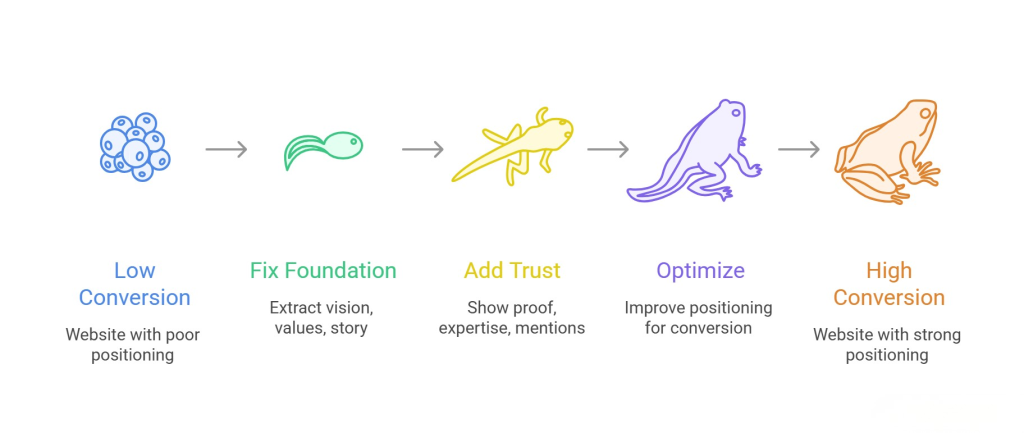
The process: Positioning before design, design before traffic. Skip a step and you’re setting money on fire.
Why Traffic Matters More Than You Want to Admit
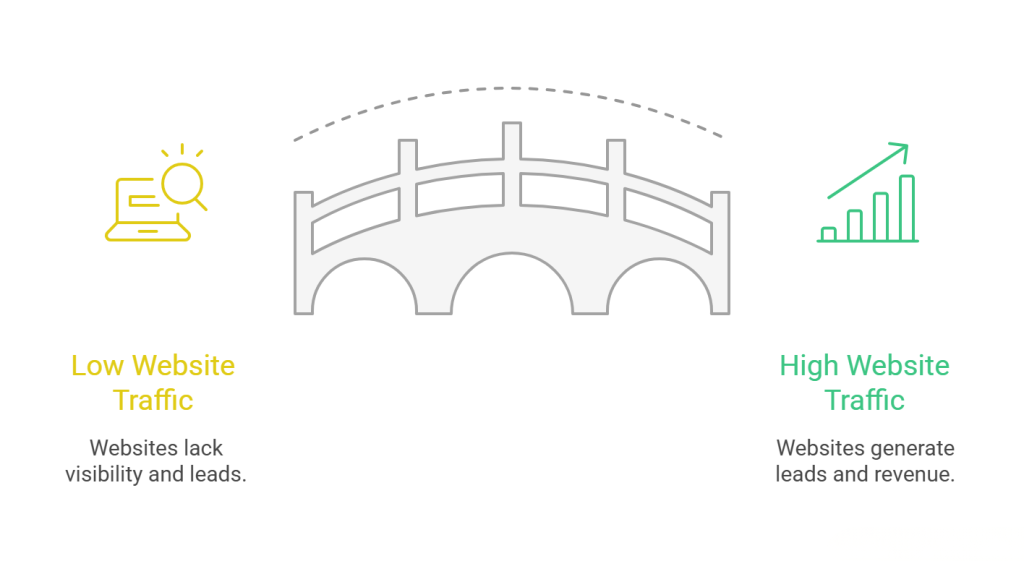
You need traffic.
Business owners build great websites, then hope people visit. Hope isn’t a strategy.
Here’s the reality:
Traffic can come from search, referrals, partnerships, paid campaigns, direct outreach, or an existing audience. The right mix depends on how the buyer discovers and evaluates providers.
A great website is your closer, not your prospector.
Here is what matters: the redesign brief should name how qualified people will reach the site and how that traffic will be measured.
Why a Redesign Needs a Measurement Plan
Choose the baseline before launch. Track qualified inquiries by page and source, form completion, booked conversations, accepted opportunities, and closed work. Keep lead quality beside conversion rate so a rise in form submissions is not mistaken for business improvement.
The website does not need to be perfect. It needs to be accurate, usable, measurable, and ready to improve from real behaviour and sales feedback.
What This Means for Your Business
If you’re tired of websites that look great but don’t deliver, we need to fix your positioning first.
Not your design. Not your traffic. Your roots.
Once the position is clear, the website can carry that message through the buyer’s questions, proof, and next step.
This is how you become the obvious choice in your market instead of another option.
The result is a redesign brief tied to a business problem rather than a collection of visual preferences.
Common Questions About Website Performance
Why do most website redesigns fail to generate leads?
They focus on design before fixing positioning. If you don’t know who you are, what makes you different, and why someone should pick you, design won’t convert visitors into customers. Clear messaging and positioning come first.
How long should strategy take before building a website?
It depends on the size of the site, the number of buyer groups, and how much evidence already exists. A focused landing page may need a short research sprint. A larger B2B website may require interviews, competitive research, content planning, and stakeholder decisions before design begins.
What trust elements do high-converting websites need?
Before and after examples, customer stories, measured outcomes with context, proof of expertise, and direct answers to common objections. Put each proof point near the claim it supports.
Should SEO be part of a website redesign?
Yes. Preserve valuable URLs when possible, map redirects before launch, keep internal links and metadata intentional, and build pages around real buyer demand. SEO results depend on the market, authority, competition, and content, so the redesign should not promise a universal timeline.
Why do some businesses wait too long to launch their website?
Internal review can continue forever because it produces no new market evidence. Launch when the site is accurate and testable, then improve it against a defined baseline using real traffic and sales feedback.
How should I compare website redesign companies?
Ask how they handle buyer research, copy, proof, SEO migration, accessibility, performance, analytics, forms, CRM handoff, and post-launch improvement. A portfolio shows visual ability. The process shows whether the company can connect the website to sales.
Is design or copywriting more important for conversions?
Both matter. Copy and structure help the buyer understand the offer, while visual design establishes hierarchy, usability, and trust. Start with the buyer and page job so the disciplines support the same decision.
What happens if I launch a website without an acquisition engine?
You’re praying someone stumbles onto your site. Hope isn’t a strategy. A great website is your closer, not your prospector. Without traffic, a perfect website is worth zero dollars. You need to drive traffic from day one.
Key Takeaways
- Beautiful websites fail when built on broken positioning. Fix your business foundation before touching design.
- Copywriting and messaging drive conversions more than visual design. Speak directly to customer needs, desires, and fears.
- Add proof, testimonials, and objection-handling near the claims they support.
- Include SEO migration, traffic sources, and measurement in the redesign brief.
- Launch when the site is accurate and measurable, then improve it with real traffic and sales feedback.
- A perfect website that nobody sees is worth zero dollars. Positioning, then design, then traffic, in the right order.