



Three stages determine whether your funnel works: Attention (qualified traffic), Buyers (belief building), and Cash (conversion plus retention). You need to fix them in sequence. Diagnose the earliest failure point, then rebuild from there.
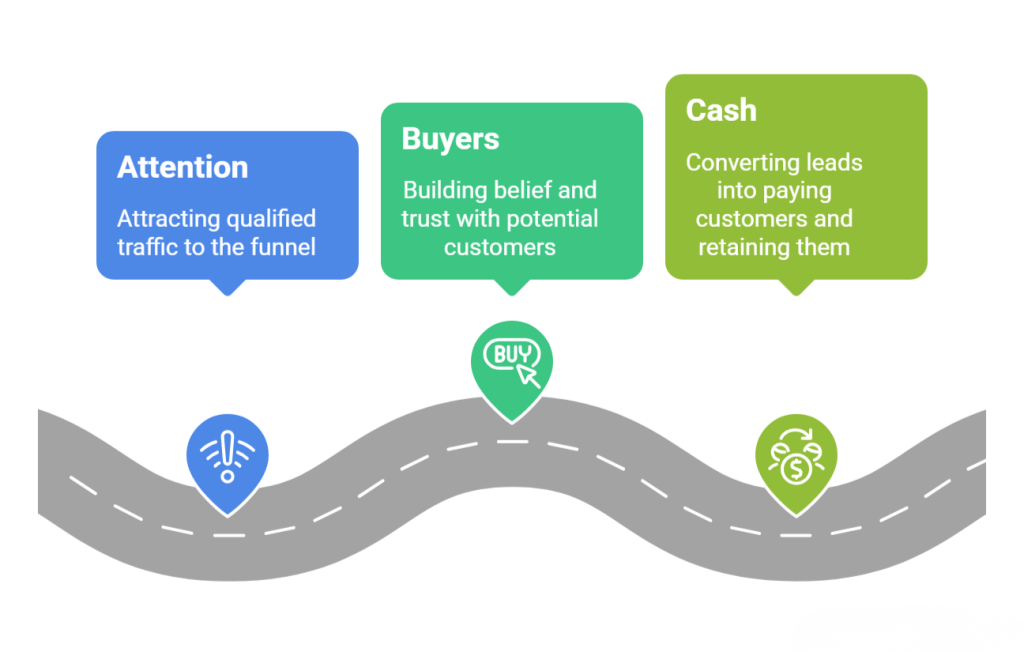
Attention: Wrong messaging pulls in unqualified traffic
Buyers: You haven’t built enough belief to turn interest into purchase intent
Cash: Conversion friction or missing retention systems block revenue
The problem isn’t execution quality. You’re fixing the wrong stage or building on a broken foundation.
Why Businesses Waste Money on Broken Funnels
I’ve watched businesses drop six figures on funnel optimization when the foundation was broken from day one.
They hire conversion specialists. They split test headlines. They build automation sequences. The funnel still doesn’t work.
The pattern I keep seeing: they optimize stages that don’t exist yet. They fix all three stages at once, which dilutes focus and masks the real bottleneck. 68% of companies haven’t identified or measured their sales funnel. They’re optimizing blind.
You need a diagnosis before you build anything.
What this means: Diagnose which stage breaks first. Fix that stage before touching anything else.
What Is the ABC Funnel Framework?
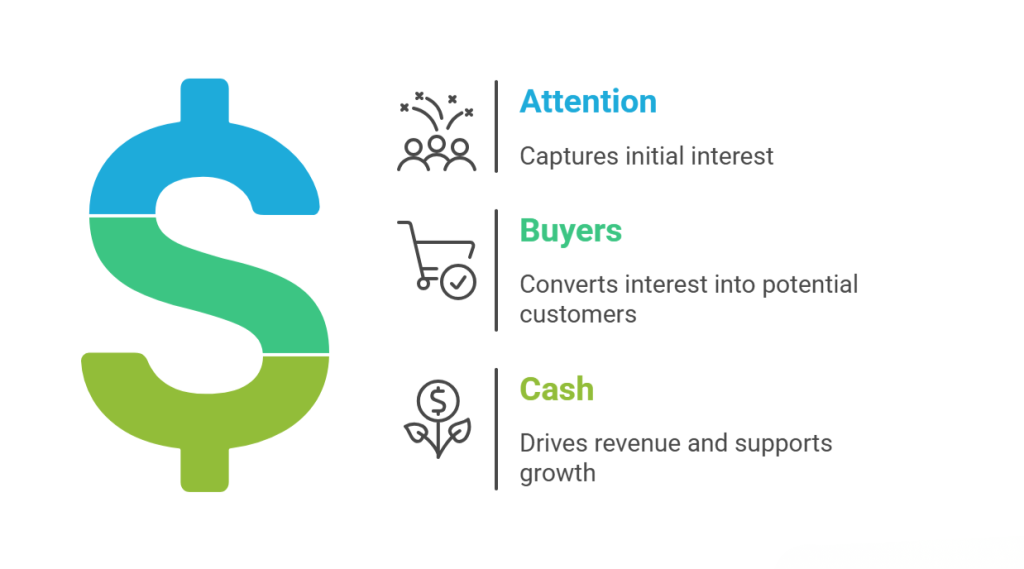
Every business needs three things to generate revenue:
1. Attention from people who could become customers
2. Buyers who are interested in your solution and believe you’re the right choice
3. Cash from converting and retaining those buyers
The middle stage is where things break down. Buyers aren’t buying yet because they don’t believe in you. They’re interested in solving their problem… they’re comparing options… but they haven’t seen you as the obvious choice.
You need to shift their beliefs systematically before they’ll convert.
When a funnel fails, it fails at one of these three stages. The fix starts with figuring out which one.
Here’s the key: ABC is a prerequisite sequence. Attention enables buyers. Buyers enable cash. You build them in order.
Stage 1: Why Attention Fails (And How to Fix It)
The Traffic Trap
You look at your analytics. Visitors are coming in. Engagement metrics look decent. So you assume attention is working and move on to optimizing the buyer stage.
Here’s the issue: attention without relevance is noise.
I worked with a client producing dance videos for traffic. Views were strong. Engagement looked good. Zero conversions. They’d attracted the wrong audience.
Wrong attention burns resources while masking the real problem. 96% of website visitors leave without converting. Only 4% convert. This isn’t a conversion problem. This is an attention quality problem.
Why Messaging Determines Attention Quality
Your messaging determines who shows up. When you try to serve everyone, you qualify no one. You end up with traffic that was never going to buy.
The fix isn’t better ads or more volume. You need to pick one customer type and speak directly to them.
This feels counterintuitive. You’re narrowing your audience when you want to grow. But it’s the only way to generate attention that converts into cash.
How to Diagnose Broken Attention
Look at your engagement patterns. Are people exploring your site or bouncing right away? Which tactics produced this traffic? What messaging did you use?
If you don’t have clear answers, your attention isn’t qualified.
The hardest part is choosing one customer segment. When you analyze the data, you’ll see one segment produces the bulk of your revenue. You’re spending resources on attention that doesn’t convert.
Action step: Analyze which customer type generates the highest revenue and lifetime value. Build your messaging to attract more of them. Stop trying to serve everyone.
Stage 2: How to Turn Attention Into Buyers
You’ve solved attention. The right people are showing up. They’re interested in what you do.
Now you need to turn that attention into buyers… people who are ready to purchase.
This is where funnels break. 79% of leads don’t make it to conversion. This isn’t a closing problem. This is a belief problem.
What Is Proof Architecture?
Turning attention into buyers requires proof architecture. You systematically dismantle the false beliefs preventing someone from buying.
Here’s an example. Someone believes marketing is only for generating new leads. But marketing also closes the leads you already have. Buyers are comparing quotes, evaluating competitors. Your marketing needs to address those comparisons and make you the obvious choice.
Building belief happens before the sales conversation, not during it.
Most businesses skip this step entirely. They go from awareness straight to offer. When conversion fails, they blame lead quality.
The leads aren’t bad. The belief-building architecture is missing.
How to Identify False Beliefs
You need to identify the specific false beliefs your customers hold. Not generic objections. Specific beliefs.
Example: Someone thinks they’ll spend less by doing marketing themselves. When you multiply their time by their hourly value, DIY marketing costs more than hiring someone. Plus, they lose the opportunity cost of using that time on higher-ROI activities.
Your job is to present the evidence. Let the truth speak for itself. They’ll make their own decision.
If you need to convince someone to work with you, you haven’t done enough marketing.
Why Objections Happen Before Sales Calls
58% of buyers say sales reps struggle to address their objections. This happens because belief-building failed upstream. The objections should’ve been addressed before the conversation.
Two-thirds of sales objections aren’t about price. They stem from psychological barriers. Surface concerns mask deeper factors.
Building belief addresses those deeper factors systematically.
How to Build a Buyer Nurture Sequence
Start with a lead magnet that solves a specific problem for your ideal customer. Make it actionable. They should be able to implement it themselves.
Use the lead magnet to qualify them. Are they interested in solving this problem? Are they looking for this transformation?
Once they’re in your funnel, deploy a nurture sequence. Use ads and content assets that demonstrate how you solve the problem. Show the risks and time costs of DIY. Show why your solution is faster and less risky.
Figure out what your audience values. Position yourself as the solution that removes the burden from them.
Then dismantle false beliefs one at a time. What do they believe right now that stops them from buying? What truth do they need to see?
92% of B2B buyers are more likely to purchase after reading a trusted review. Industry-specific case studies convert five times better than generic ones. Belief requires evidence, not feature lists.
Key takeaway: Building belief means dismantling false beliefs systematically before the buyer reaches your sales process. Use lead magnets to qualify, nurture sequences to educate, and proof (reviews, case studies, data) to build trust.
Stage 3: The Cash Conversion Stage
When you have the right attention and you’ve turned that attention into qualified buyers who believe in you, the cash stage should be frictionless.
This is where most businesses think the problem lives. They optimize checkout processes and closing techniques. But if attention is wrong or you haven’t built belief with your buyers, no amount of cash stage optimization will fix it.
The cash stage is a lagging indicator of every prior stage’s integrity.
When the foundation is built correctly, cash conversion becomes simple. Maybe it’s a call. Maybe it’s a checkout process. Maybe it’s an in-person conversation. It needs to be the least resistant process for them to get started working with you.
Here’s what most businesses miss: the cash stage doesn’t end at transaction completion.
The LTV Feedback Loop
Once you’ve acquired a customer, you need retention. How do you retain this customer? How do you increase their lifetime value so cash flow continues to increase?
The higher your LTV, the more money you spend on attention to drive more buyers.
This creates a feedback loop. Better retention funds better attention, which brings in more qualified buyers, which increases LTV further.
Acquiring new customers costs five times more than retaining existing ones. Retaining current customers is 6 to 7 times less costly than acquiring new ones.
When customer retention rate increases by 5%, profit increases by over 25%. Small improvements at the cash stage multiply acquisition capacity.
Most businesses chase new attention while neglecting the economic engine.
What a Healthy Cash Stage Looks Like
You have a predictable way to acquire leads. You have a system to retain and ascend customers into higher-ticket products. You have upsells and downsells.
You have a system to stay top of mind with buyers so they’re ready when the time comes.
There are people on the fence. People comparing quotes, looking at other solutions. These are buyers. They’re interested in solving their problem. They haven’t seen you as the obvious choice yet.
You need to speak to their false beliefs. Price. Speed. Results. “Are they going to deliver what they promise?”
Address those objections systematically. Help them change those beliefs.
What this means: A healthy cash stage combines low-friction conversion with retention systems that increase lifetime value. Both feed the attention stage.
Why You Can’t Fix All Three Stages at Once
Here’s where businesses get it wrong. They try to optimize all three stages at the same time.
They’re running ads for attention while rebuilding their website for conversion while creating nurture sequences to build belief with buyers. Everything happens at once.
Each funnel stage is a prerequisite for the next. You don’t optimize them in parallel.
If attention is broken, trying to convert them into buyers is pointless. If you haven’t built belief with your buyers, optimizing cash conversion is pointless.
The industry trains you to think tactically. 7 out of 10 marketers are involved in conversion rate optimization, but only 22% of businesses are satisfied with the results. They’re adding tactical sophistication without foundation clarity.
Complexity feels like progress. It multiplies the failure points.
How to Diagnose Which Stage Is Broken
Start with the data. Look at your marketing qualified leads versus sales qualified leads. Where’s the bottleneck?
Do you have people interested in your products and services but they’re not converting into cash? That’s a buyer belief or cash problem.
Do you have attention but it’s not turning into people interested to buy? That’s an attention quality problem.
72% of companies with fewer than 50 opportunities in their pipeline didn’t reach their monthly revenue goals. Volume at the attention stage directly determines cash outcomes. Most businesses focus on closing tactics rather than attention quality.
Work backwards from cash. If cash conversion is low, check if you’ve built belief with your buyers. If buyers aren’t qualifying, check attention quality. Find the earliest stage failure.
Then fix that stage before moving forward.
Diagnostic process: Work backwards from cash to buyers to attention. Find where the break happens first. That’s your starting point.
How to Rebuild Your Funnel
When I work with clients, we start with diagnosis. We look at ABC. We identify where the bottleneck is.
Then we work on one thing at a time.
If attention is broken, we fix messaging and targeting before we touch anything else. We make sure the attention is qualified. We make sure the people coming in become customers.
If we’re not converting attention into buyers, we build the proof architecture. We identify false beliefs. We create the evidence structure. We build the nurture sequence that systematically addresses objections before they reach sales.
If cash is broken, we simplify the conversion process and build the retention system.
One stage at a time. In sequence.
This feels slow. It feels like you’re not doing enough. But it’s the only way to build a funnel that works.
The alternative is what most businesses do. They add complexity to mask foundation absence. They chase tactics because tactics feel like action.
If you show an ad to 1,000,000 people and only convert 1%, your ad failed 99% of the time. The funnel doesn’t fail at close. It fails at qualification.
Rebuild sequence: Diagnose the earliest stage failure. Fix that stage completely. Move to the next stage. Repeat.
What It Takes to Fix a Broken Funnel
Here’s the hard part. Fixing a broken funnel requires abandoning tactics that feel productive but don’t address the diagnosed stage failure.
You need to stop doing what looks like progress and return to ABC basics.
Most businesses lack the conviction to do this. They’d rather add another automation sequence or hire another specialist than admit the foundation is broken.
In B2B SaaS, a lead qualification rate of around 25 to 35% is typical, though top performers see rates as high as 50%. Qualification rate determines everything downstream.
Fixing close rates when qualification is broken wastes resources.
Companies that create an easy buying process are 62% more likely to win a high-quality sale. The cash stage should be frictionless. But only after attention is qualified and you’ve built belief with your buyers.
Simplifying checkout doesn’t fix upstream qualification failure.
The commitment: You abandon tactics that feel like progress. You return to foundation work. You fix the earliest failure point before adding sophistication.
Frequently Asked Questions
What is the ABC funnel framework?
ABC stands for Attention, Buyers, Cash. Attention means attracting qualified traffic. Buyers means converting that attention into people who believe you’re the right choice. Cash means converting and retaining those buyers. Each stage is a prerequisite for the next.
How do I know which funnel stage is broken?
Work backwards from cash. If you have buyers but no cash, your conversion or retention is broken. If you have attention but no buyers, your belief-building is broken. If you have neither, your attention quality is broken. Look at your MQL to SQL conversion rates to pinpoint the bottleneck.
Why do 96% of website visitors leave without converting?
This is an attention quality problem, not a conversion problem. When your messaging tries to serve everyone, you attract unqualified traffic. People visit, realize you’re not for them, and leave. Fix this by narrowing your messaging to one customer type.
What is proof architecture?
Proof architecture is the systematic process of dismantling false beliefs that prevent someone from buying. You identify specific false beliefs (like “DIY is cheaper”), then use evidence (data, case studies, reviews) to shift those beliefs before the sales conversation.
How long does it take to fix a broken funnel?
It depends on which stage is broken and how deep the foundation issues go. Fixing one stage completely before moving to the next takes longer than surface-level optimization across all stages, but it produces sustainable results. Most businesses see measurable improvement within 60 to 90 days of focused work on the diagnosed stage.
Should I optimize all three funnel stages at once?
No. Each stage is a prerequisite for the next. Optimizing them in parallel dilutes focus and masks the real bottleneck. You diagnose which stage breaks first, fix that stage completely, then move to the next stage in sequence.
What’s the difference between MQL and SQL?
MQL (Marketing Qualified Lead) is someone who has shown interest in your solution. SQL (Sales Qualified Lead) is someone who is ready to buy. The gap between MQL and SQL reveals whether your belief-building architecture is working. If you have high MQL but low SQL, you’re not converting attention into buyers.
Why does higher LTV matter for the attention stage?
Higher lifetime value means you make more money per customer, which means you spend more to acquire each customer. This lets you outbid competitors for attention, invest in better messaging, and attract higher-quality traffic. LTV creates a feedback loop that funds the entire funnel.
What to Do Next
Stop optimizing your funnel until you know which stage is broken.
Look at your data. Where’s the drop-off? Is it attention quality? Is it turning attention into buyers? Is it cash conversion?
Find the earliest stage failure. Fix that stage before you touch anything else.
Work on one thing at a time. In sequence. ABC: Attention, Buyers, Cash.
It’s going to feel slow. It’s going to feel like you’re not doing enough. But this is how you build a funnel that converts attention into cash.
Diagnose first. Rebuild from the foundation forward.
Key Takeaways
Funnel failure happens at one of three stages: Attention (wrong messaging attracts unqualified traffic), Buyers (you haven’t built belief to convert interest into purchase intent), or Cash (conversion friction or missing retention systems).
ABC is a prerequisite sequence: Attention enables buyers. Buyers enable cash. You build them in order, not simultaneously.
Attention quality matters more than attention volume: 96% of visitors leave without converting because messaging is too broad. Pick one customer type and speak directly to them.
Building belief happens before the sales conversation: Two-thirds of sales objections stem from psychological barriers, not price. Use proof architecture (lead magnets, nurture sequences, case studies) to dismantle false beliefs systematically.
The cash stage doesn’t end at transaction: Retention and lifetime value create a feedback loop that funds the attention stage. A 5% increase in retention increases profit by over 25%.
You fix stages in sequence, not in parallel: Diagnose the earliest stage failure. Fix that stage completely. Move to the next stage. Complexity without foundation clarity multiplies failure points.
Foundation work feels slow but produces sustainable results: Most businesses chase tactics because tactics feel like action. Fixing qualification before optimizing close rates is how you build a funnel that works long-term.