



Marketing fails before it starts when you skip category definition. Without clear category placement, prospects compare you to the wrong competitors on price alone. Foundation work isn’t optional overhead… it’s the prerequisite that makes tactics work.
I’ve watched the same pattern repeat for years. A company contacts me asking for better ads, more sophisticated campaigns, increased channel presence. They want tactics. They want visible activity. They want something to show their board.
The real problem sits one layer below the surface.
They don’t know what category they’re in. Or they think they do, but when I probe, the answer needs three paragraphs and multiple qualifiers. Every dollar spent on marketing before this gets fixed is wasted effort.
Here’s what happens without category clarity: prospects default to price comparison in the wrong market. Your differentiated offering becomes a commodity. You compete on price against the wrong competitors.
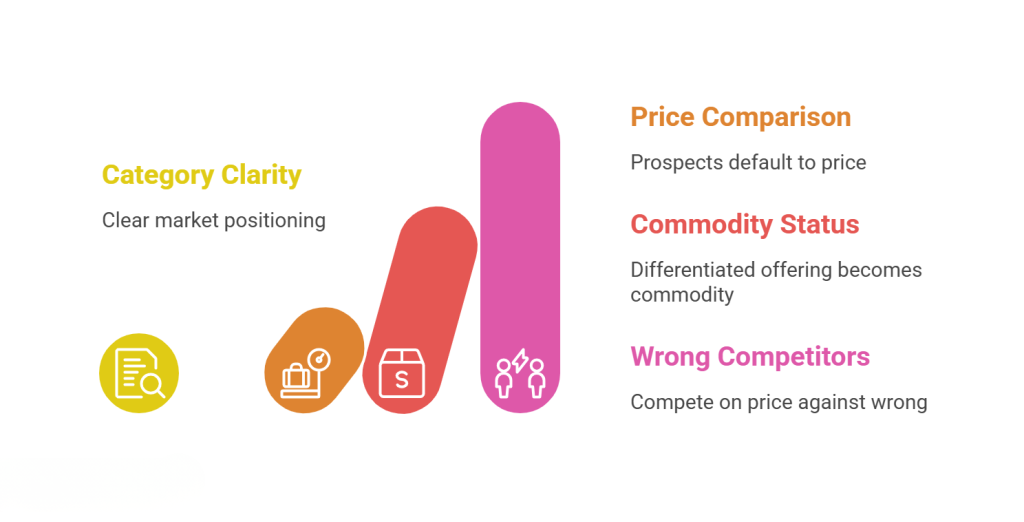
What Category Confusion Looks Like
Companies grow through direct effort and personal relationships. Then they hit a wall when trying to systematize what worked. The founder’s personal touch stops scaling.
They assume the problem is execution quality. Better creative. More channels. Smarter targeting.
The problem is simpler.
Prospects don’t understand what category you’re in. When people fail to place you in a clear mental bucket, they compare you with whatever seems adjacent. They’re price shopping in the wrong category entirely.
You end up competing on price in a commodity market, even when your offering is differentiated. Research shows that 76% of market cap goes to the category leader, while everyone else fights over the remaining 24%. The leader doesn’t have better tactics. They defined the category first.
Key Pattern: Category confusion forces commodity competition regardless of actual differentiation.
Why Companies Skip Foundation Work
The incentive structure works against you.
Agencies get paid to deploy tactics. Consultants bill for visible activity. Internal teams get judged on campaign launches and channel expansion. Nobody’s compensation model rewards pausing to say, “We need to clarify our category first.”
Foundation work feels like delay. Looks like overhead. Doesn’t produce screenshots for board meetings.
Tactics without strategy look like progress in the short term.
I’ve seen companies burn six-figure budgets on sophisticated multi-channel campaigns built on category confusion they never diagnosed. The tactics were executed well. The creative was solid. The targeting was precise. They were solving the wrong problem.
Core Reality: Economic incentives reward tactical deployment over diagnostic accuracy, even when diagnosis determines the outcome.
How to Know If Your Foundation Is Missing
Here’s the test I use. If you need more than one sentence to explain your category position without qualifiers, your foundation is unstable.
Not your value proposition. Not your differentiators. Your category.
Someone who’s never heard of you should understand what bucket you belong in within seconds. They should immediately grasp the type of problem you solve and the type of solution you represent.
If the answer requires a paragraph of explanation, you’re building on unstable ground.
I watched this with a client who spent months optimizing ad copy and landing pages. Conversion rates stayed flat. We stopped all tactical work and spent two weeks clarifying their category position. Once prospects understood what type of solution they were evaluating, conversion rates doubled without changing a single ad.
The tactics stayed the same. The foundation changed.
Diagnostic Signal: If you need more than one sentence to explain your category, you have a foundation problem, not a tactics problem.
What Happens When You Skip This Step
Tactical sophistication accelerates failure when foundation is missing.
More channels spread confusion across more places. Better creative communicates the wrong message more effectively. Increased spend funds misalignment at scale.
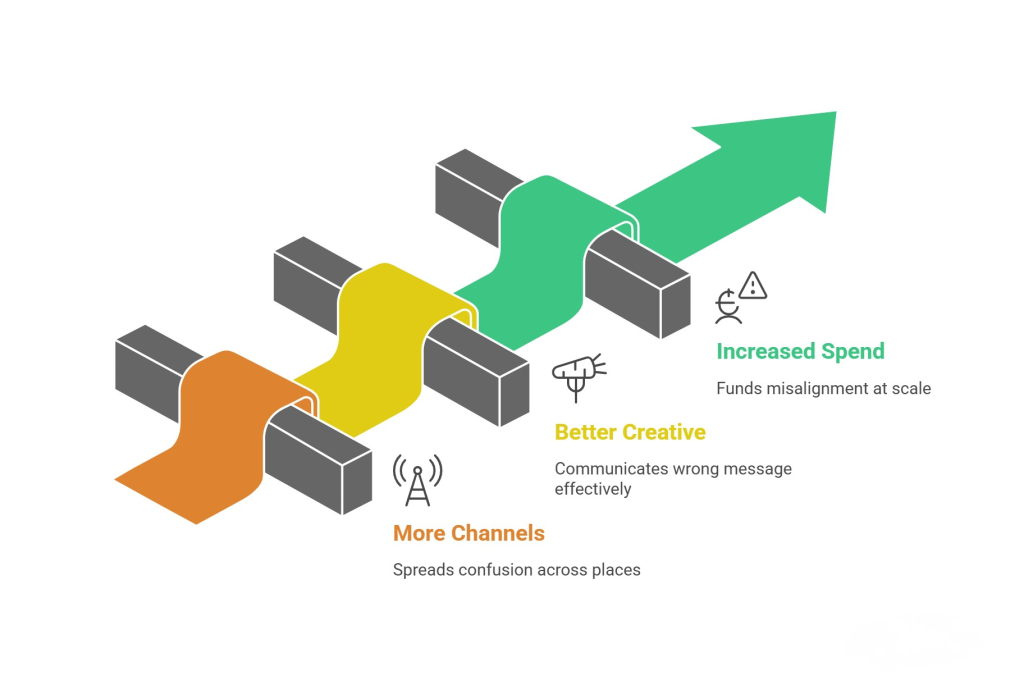
You’re not failing because execution is weak. You’re failing because you’re executing the wrong thing.
Studies show marketers waste roughly 37% of their budget on misaligned efforts. Not a tactics problem. A foundation problem.
Here’s where this gets worse. When tactics fail, companies assume they need different tactics. They try new channels. Hire new agencies. Chase new methodologies.
The pattern repeats because the subsurface problem never got addressed.
Observable Pattern: Tactical proliferation without foundation clarity compounds failure rather than corrects it.
What Foundation Work Involves
Foundation work isn’t glamorous. Doesn’t produce immediate results. Feels slow compared to launching a new campaign.
Here’s the work.
First, identify the specific problem you solve in language prospects already use. Not your solution. Not your features. The problem they recognize.
Second, understand what category prospects mentally file you under when they first encounter you. If they’re filing you in the wrong category, every message you send gets interpreted through the wrong lens.
Third, clarify whether you’re competing in an existing category or creating a new one. Both are valid. The tactics required for each are completely different.
Fourth, test whether your category position creates natural differentiation or forces commodity competition.
This work takes time. Requires research. Demands honesty about where you sit in the market, not where you wish you sat.
Once done, tactics work better because they’re aligned with how prospects already think.
Foundation Components: Problem recognition, category placement, competitive context, differentiation testing.
When Foundation Work Becomes Mandatory
Not every company needs this work immediately. If you’re still in validation phase, testing product-market fit, figuring out if anyone wants what you’re building, tactics help you learn.
When you cross into growth phase, foundation work becomes prerequisite.
Here’s the pattern. Companies grew through direct relationships and personal effort. Then they hit a replication barrier. What worked when the founder was in every sales conversation stops working when they try to hire a team and systematize the approach.
When growth through personal effort stops scaling, you need foundation work before more tactics.
Companies skip this step and keep hiring more salespeople, launching more campaigns, expanding into more channels. They keep hitting the same invisible ceiling because the ceiling isn’t about execution capacity.
It’s about category clarity.
Transition Signal: When personal effort stops scaling and systematization attempts fail, foundation work precedes tactical expansion.
What Changes When You Get This Right
I’ve seen what happens when companies do this work.
Prospects stop asking for price comparisons because they’re not mentally grouping you with commodity alternatives. Sales conversations get shorter because you’re not fighting category confusion. Marketing messages land faster because they align with how people already think.
The tactics don’t necessarily change. They work better because they’re built on stable ground.
One client spent a year trying different marketing tactics with mediocre results. We paused everything and clarified their category position. Within three months of redeploying the same basic tactics with clear foundation, their pipeline doubled.
Same team. Same budget. Different foundation.
Not a methodology. Not a framework. The pattern you see when you stop treating symptoms and address the subsurface structure.
Outcome Pattern: Foundation clarity multiplies tactical effectiveness without changing the tactics themselves.
Start Here
If your marketing keeps underperforming despite solid execution, stop adding more tactics.
Someone who’s never heard of you should understand your category position in one sentence. If they don’t, that’s your starting point.
Figure out what problem you solve in language your prospects already use. Clarify what category they mentally file you under. Test whether your category creates differentiation or forces commodity competition.
Do that work before launching another campaign.
Foundation work feels slow. Tactics without foundation create expensive noise. Noise doesn’t compound into momentum. Clarity does.
Common Questions About Category Foundation
How long does foundation work take?
Two to four weeks for most companies. You’re clarifying category position, not inventing a new market. The timeline depends on how much confusion exists and how honest you’re willing to be about your current position.
Do I need to pause all marketing while I do this?
Not necessarily. Keep running what’s working. Pause expansion plans and new campaigns until foundation is clear. Otherwise you’re spreading confusion faster.
What if I’m creating a new category?
Foundation work becomes more important, not less. You need to define the problem category before you define your solution. Prospects need to recognize the problem exists before they’ll evaluate your approach to solving it.
How do I know if my category is clear enough?
Test it. Show your category description to someone outside your industry. If they understand what type of problem you solve and what type of solution you offer in under 10 seconds, you’re clear. If they need explanation, you’re not.
Won’t clarifying my category limit my market?
The opposite happens. Category clarity attracts the right prospects and repels the wrong ones. You trade lower volume for higher conversion. You’re better off with fewer, better-fit prospects than high volume of confused leads.
What if my competitors don’t have clear categories either?
Better for you. Being first to clarity in a confused market creates category leadership by default. Your competitors are gift-wrapping the opportunity.
Do I need to hire someone to do this work?
Not always. If you understand your market and prospects deeply, you do this internally. If you’re too close to the problem or lack market perspective, outside help accelerates the process. The work requires honesty more than expertise.
What’s the difference between category and positioning?
Category defines what bucket prospects file you under. Positioning defines where you sit within that category. You need category clarity before positioning matters. If prospects are filing you in the wrong category, your positioning work is wasted effort.
Key Takeaways
-
Marketing failure starts before tactics launch, when category definition work gets skipped
-
Category confusion forces commodity competition on price, regardless of actual differentiation
-
Economic incentives reward tactical deployment over diagnostic work, even when diagnosis determines outcomes
-
The diagnostic test: if you need more than one sentence to explain your category, foundation is unstable
-
Tactical sophistication accelerates failure when foundation is absent
-
Foundation work becomes mandatory when growth through personal effort stops scaling
-
Category clarity multiplies tactical effectiveness without changing the tactics themselves