



Business revenue plateaus because founders stay trapped in technician mode. Random marketing activities replace systematic growth engines. Breaking through requires shifting from doing the work to building systems around positioning, acquisition, and documented processes.
Why Your Business Is Stuck:
-
You’re the bottleneck. Every client, decision, and marketing task depends on you personally.
-
Random Acts of Marketing create unpredictable results instead of consistent lead flow.
-
Weak positioning leads to scattered tactics that waste time and budget.
-
Growth systems (clear positioning + repeatable acquisition + documented processes) are the bridge to $1M+.
I’ve seen this pattern play out hundreds of times.
A service business hits $300K to $500K in revenue. The founder worked hard to get there. Referrals came in. Word of mouth spread. The quality of work spoke for itself.
Then everything stops.
Revenue flatlines. The founder works harder but the numbers stay the same. More hours, same income. More effort, same results.
The problem? You’re still operating like a technician when you need to think like a systems builder.
What Is the Technician Trap?
When you started your business, being the technician made sense. You delivered the service. You talked to clients. You handled everything because you had to.
And that approach got you here.
But at this revenue level, you become the bottleneck.
Every client needs you. Every decision waits for you. Every piece of marketing depends on you remembering to post something when you have time.
60% of founders remain heavily involved in daily operations years after starting their business. The business grows only as much as the founder personally manages.
This creates an invisible ceiling.
The Bottom Line: What got you to $300K-$500K won’t get you to $1M (or whatever your scenario looks like). Being the technician stops being a strength and starts being the limit.
Why Random Acts of Marketing Keep You Trapped
Look at your marketing over the past three months.
You posted on social media when you remembered. You ran some ads for a few weeks. You updated your website. You tried a new platform someone recommended.
Each action made sense in the moment. Nothing connected to anything else.
I call this Random Acts of Marketing.
You’re doing marketing activities without a system. Reacting instead of executing a plan. Hoping something works instead of knowing what works.
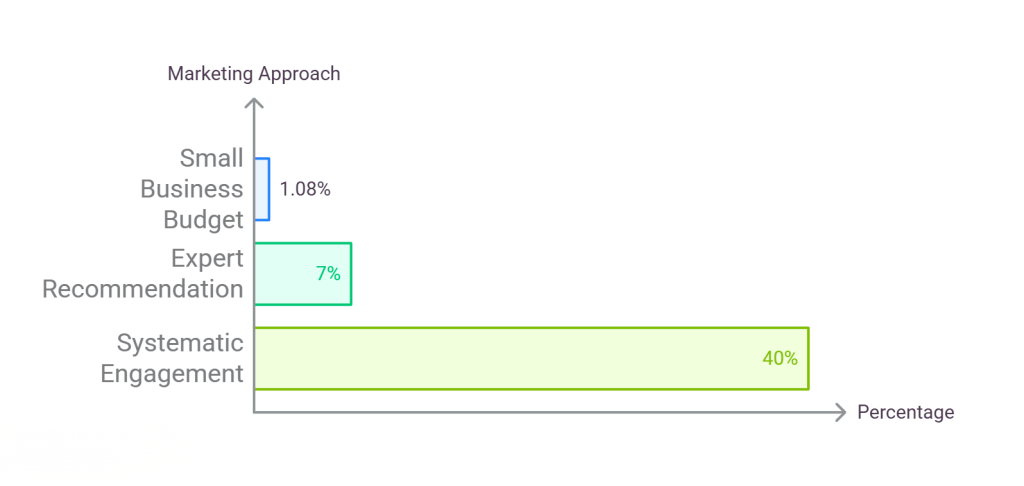
Small businesses allocate only 1.08% of their budget to marketing when experts recommend 7%. Businesses using systematic approaches see 40% higher engagement than those posting randomly.
Random acts create feast or famine cycles. Leads come in waves. Revenue spikes and drops. You’re flying blind on next month’s numbers.
This happens because weak positioning leads to scattered tactics. When you don’t know exactly who you serve and why they choose you, every marketing channel seems equally important. You try everything and master nothing.
What This Means for You: Without a system, your marketing depends on memory, energy, and luck. Systems create predictable lead flow. Random acts create chaos.
Why Most Service Businesses Never Break Through $1M
Only 9% of small businesses ever reach $1 million in revenue.
The gap between $300K and $1M isn’t about working harder. Small businesses with one to five employees average $387K per year. Those with five to nine employees generate at least $1 million annually.
The difference is systems.
At $300K, you touch everything. At $1M, you need processes working without you. Marketing running consistently. Lead generation independent of your personal network.
Most service businesses plateau around $2 to $3 million because the expertise driving success becomes the scaling limitation. Every new client requires the founder’s personal attention.
The founder becomes the product. And you don’t scale yourself.
Key Insight: The expertise getting you to $300K becomes the ceiling preventing $1M. You need systems replacing personal involvement, not more hours in your day.
What Staying in Technician Mode Costs You
Operating as the technician costs you in ways compounding over time.
You make hiring decisions based on immediate needs instead of building a team running systems. You hire people to help you do the work when you need people owning the work.
Your marketing stays inconsistent because it depends on your available time and energy. Client work gets busy, marketing stops. Marketing stops, leads dry up. Leads dry up, you panic and start random acts again.
You don’t take time off because too many things require your direct involvement. The business doesn’t run without you. You stay trapped in daily operations.
Your positioning stays weak because you never have time to clarify it. You serve whoever will pay you instead of becoming known for solving a specific problem for a specific type of client.
This creates chronic anxiety. You know there’s more to build, but you’re too busy keeping the current operation running.
The Real Cost: Staying in technician mode doesn’t preserve your business. It slowly kills your ability to grow, rest, or build something valuable.
What Growth Systems Look Like
A growth system is different from random marketing acts.
It starts with clear positioning. You know exactly who you serve, what problem you solve, and why someone chooses you over alternatives. This clarity makes every other decision easier.
Then you build an acquisition engine. This is a repeatable process bringing in qualified leads consistently. Content establishing authority. A referral system turning clients into advocates. Strategic partnerships creating steady deal flow.
The key word is repeatable.
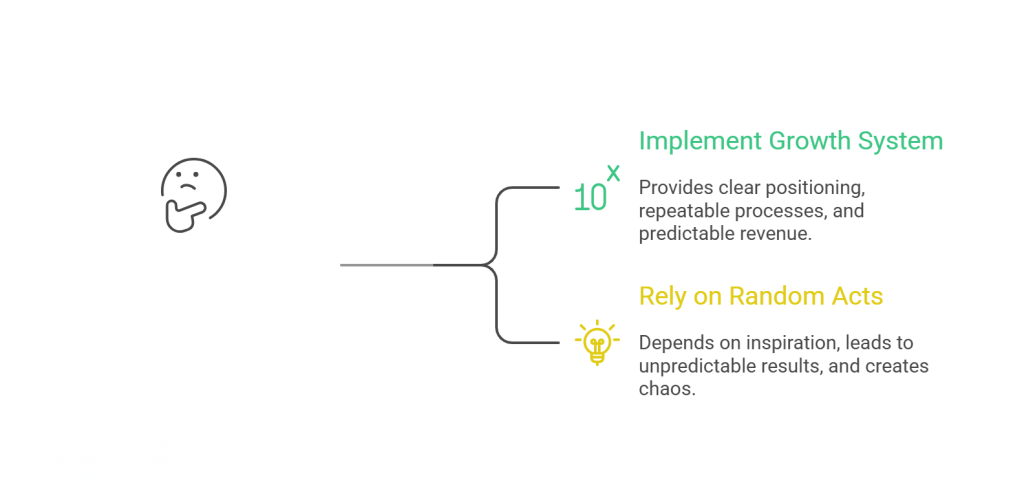
Random acts depend on inspiration and available time. Systems run whether you feel like it or not. Random acts create unpredictable results. Systems create predictable revenue.
You also need to extract your knowledge from your head and put it into processes. When everything you know lives in your brain, you’re the bottleneck. When your knowledge exists in documented systems, other people execute at your level.
This doesn’t mean removing yourself from client work immediately. It means building the foundation making removal possible later.
Systems vs. Random Acts: Random acts depend on you showing up inspired. Systems work whether you’re there or not. One creates chaos. The other creates predictable growth.
Why You Need Foundation Before Volume
Most businesses make the same mistake.
They try to add volume before fixing the foundation. More leads before clarifying positioning. Scaling before building systems.
It’s like pouring water into a cracked bucket and wondering why it stays empty.
Beautiful websites and clever campaigns don’t work if your foundation is broken. More ads waste more money when your positioning is unclear. More content creates more noise when you don’t know who you’re talking to.
The businesses breaking through the $300K ceiling do something different. They stop. They fix their roots. They clarify their positioning. They build their acquisition engine. They document their processes.
Then they add volume.
When you have strong positioning, clear systems, and documented processes, growth becomes predictable. You know what activities produce results. You delegate execution. You forecast revenue.
The business starts working for you instead of you working for the business.
Foundation First: Adding volume to a broken foundation doesn’t accelerate growth. It accelerates waste. Fix your roots, then scale what works.
How to Shift From Technician to Builder
This shift requires changing how you spend your time.
Right now, you spend 80% of your time doing the work and 20% thinking about the business. To break through the ceiling, you need to flip that ratio.
Step 1: Audit where your time goes. Track it for two weeks. You’ll find many tasks don’t require your specific expertise. They need someone who knows the process.
Step 2: Document those processes. Write down the steps. Record yourself doing the work. Create checklists. Make it possible for someone else to execute without asking you questions.
Step 3: Fix your positioning before you spend another dollar on marketing. Get clear on who you serve and why they choose you. This clarity makes every marketing dollar work harder.
Step 4: Build one acquisition channel working consistently before adding more. Master content or referrals or partnerships. Get one system producing predictable results. Then add the next one.
Step 5: Stop doing random acts of marketing. Every marketing activity connects to your positioning and feeds your acquisition engine. If it doesn’t, stop doing it.
Action Steps: Audit your time. Document processes. Fix positioning. Build one acquisition channel. Kill random acts. Do these in order, not all at once.
What Happens When You Build Systems
When you shift from technician to builder, the business changes.
Leads come in consistently instead of in waves. You predict revenue three months out. You plan hiring based on growth trajectory instead of panic.
Your positioning becomes clear to the market. People know what you do and who you serve. Referrals get easier because people explain what makes you different.
You build assets instead of renting results. Your content compounds over time. Your systems get stronger with each iteration. Your team becomes more capable.
The business gains value beyond your personal involvement. Someone runs it without you. You’ve built something real.
This doesn’t happen overnight. Building systems takes focused effort. But the alternative is staying trapped at your current ceiling, working harder every year for the same income.
The Transformation: Systems turn unpredictable revenue into forecasted growth. Random acts into strategic assets. Founder dependence into real business value.
The Choice You Face
You’re at a decision point.
Keep operating as the technician. Keep doing random acts of marketing. Keep hoping something breaks through. Keep working harder for the same results.
Or make the shift to builder. Fix your foundation. Build your systems. Create predictable growth.
Your revenue ceiling isn’t about your capability. You already proved you build a business. The ceiling exists because you’re using the wrong approach for the next level.
What got you here won’t get you there.
The businesses breaking through understand this. They stop being the technician. They build the systems. They fix their roots before they try to rise.
That’s the only way to turn a $300K business into a $3M business.
Frequently Asked Questions
What is the Technician Trap?
The Technician Trap happens when a founder stays focused on doing the work instead of building systems. You become the bottleneck because every client, decision, and marketing task depends on you personally. This creates an invisible ceiling around $300K-$1M in revenue.
Why do service businesses plateau?
Service businesses plateau because the founder’s personal involvement becomes the limiting factor. You touch everything at $300K, but scaling to $1M+ requires processes working without you. Only 9% of small businesses reach $1M because most never make this shift.
What are Random Acts of Marketing?
Random Acts of Marketing are disconnected marketing activities done without a system. Posting when you remember, running ads for a few weeks, trying platforms someone recommended. Each action makes sense alone, but nothing connects. This creates feast or famine cycles instead of predictable lead flow.
What is a growth system?
A growth system combines three elements: clear positioning (who you serve and why they choose you), a repeatable acquisition engine (consistent lead generation), and documented processes (your knowledge extracted from your head). Systems run whether you feel like it or not, creating predictable revenue instead of unpredictable results.
How long does it take to shift from technician to builder?
Building systems takes focused effort over months, not weeks. Start by auditing your time for two weeks, then documenting processes, fixing positioning, and building one acquisition channel. This doesn’t happen overnight, but the alternative is staying trapped at your current revenue working harder every year.
Do I need to stop doing client work to build systems?
No. Building systems doesn’t mean removing yourself from client work immediately. It means creating the foundation making removal possible later. Document processes while you do them. Clarify positioning between projects. Build one acquisition channel consistently. Systems and client work happen in parallel.
What’s the difference between $300K businesses and $1M+ businesses?
Small businesses with one to five employees average $387K per year. Those with five to nine employees generate at least $1M annually. The difference is systems. At $300K, you touch everything. At $1M, you need marketing running consistently, processes working without you, and lead generation independent of your personal network.
Why should I fix my foundation before adding more marketing?
Adding volume to a broken foundation doesn’t accelerate growth. It accelerates waste. More ads waste more money when your positioning is unclear. More content creates more noise when you don’t know who you’re talking to. Fix your roots (positioning, systems, processes), then scale what works.
Key Takeaways
-
The Technician Trap creates an invisible ceiling at $300K+ where you become the bottleneck for every client, decision, and marketing task.
-
Random Acts of Marketing (disconnected activities without a system) create feast or famine cycles instead of predictable lead flow.
-
Only 9% of small businesses reach $1M because most never shift from doing the work to building systems around positioning, acquisition, and processes.
-
Growth systems are repeatable. They run whether you feel like it or not, creating predictable revenue instead of depending on your memory and energy.
-
Fix your foundation before adding volume. More marketing on broken positioning wastes money. Strong roots enable scalable growth.
-
The shift from technician to builder requires changing how you spend time: audit where time goes, document processes, fix positioning, build one acquisition channel, kill random acts.
-
Systems turn unpredictable revenue into forecasted growth, random acts into strategic assets, and founder dependence into real business value someone runs without you.